


Yesterday I gave a talk at VivaTech’s Exec Arena, in front of 500 executives. One claim: cut your juniors today, and you have no leaders in 2030. Most of you weren’t in the room, so here is the full argument, with the numbers.
I was the fourth AI talk of the day. The first three were about humanity. Mine was about your org chart.
I’ll start with the part where the cutters are right. A senior content strategist costs 90 grand a year. An enterprise Claude seat costs $200 a month. Four CMOs in ten are cutting labor costs this year, and on a 12-month view they win: the margin goes up, the board claps.
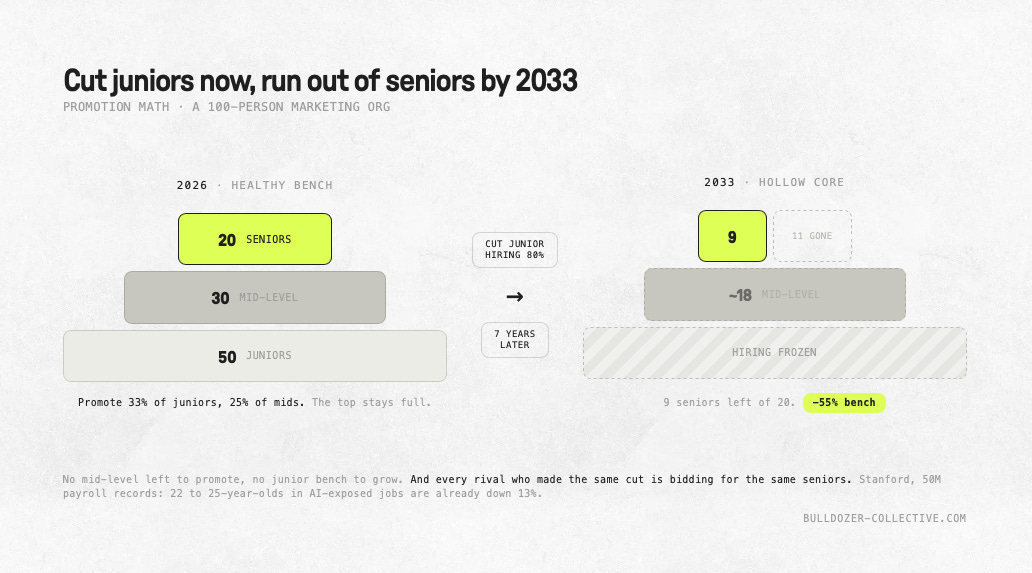
But a business doesn’t expire in 12 months. Your 2030 seniors are your 2026 juniors, and there is no other supply.
Cut the bottom of the ladder today, and in five years you bid for senior talent against every rival who made the same cut.
This already shows in payroll data. Stanford read 50 million American records: since ChatGPT launched, workers aged 22 to 25 in the most AI-exposed jobs are down 13%, while older workers in the same jobs are up 9%.
A leaner team is the wrong target. You want the one that comes out of the shock stronger, because it kept hiring and training juniors while everyone else cut. Nassim Taleb has a word for it: anti-fragile.
It doesn’t happen by accident. You build it, and here’s how.
Stop organizing marketing by channel
I run a marketing agency and most of you run marketing, so I’ll build this where I know it best. The shape holds in legal, finance, sales.
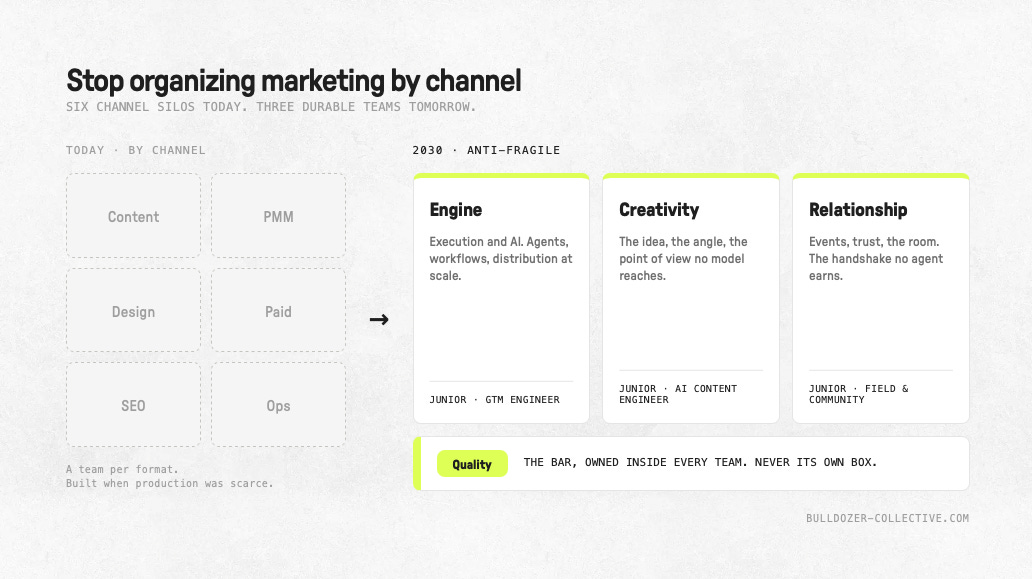
Open your org chart. Content. PMM. Design. Paid. SEO. Ops. Every box is a channel or a craft. That structure was built when production was scarce: you needed a team per format because making things was slow and expensive.
Production is now cheap. Claude writes the brief, the ten variations, and the report on the variations. So the anti-fragile org I recommend, the one we run at Bulldozer, rebuilds around three teams.
1️⃣ Engine.
Execution and AI. Distribution at scale, agents, the workflows that turn one idea into two hundred assets. Paid, ops, martech and most of production collapse here, and it runs like an engineering team: skills, QA loops, shipping cadence. Its junior is the GTM Engineer.
2️⃣ Creativity.
The idea, the angle, the brand, the point of view no model reaches on its own. When everyone ships at volume, the only edge left is the thing worth shipping. Taste lives here.
3️⃣ Relationship.
Events, dinners, communities, partners, the customers who buy because they trust you. The more the market drowns in AI output, the more a handshake is worth. No agent earns trust.
One thing sits across all three, never inside one: quality. I don’t believe in a “quality team” any more than a “good-decisions team”. Every box needs someone who owns the bar.
Run the test I give every leader: pull four sentences from your last reporting, slip in one written by AI, read them to your team. Half pick wrong. That trained eye is now a job inside each of the three.
The boxes re-sort. Paid and ops go to Engine; brand, content and positioning go to Creativity; field, community and customer marketing go to Relationship. Nobody keeps a team because the channel existed in 2019.
Take my own team. I’m a control freak. I re-edit everyone’s work, especially in marketing, because the quality bar is the one thing I won’t hand off. For years that meant me, personally, behind every draft my content manager Charlotte shipped, the exact same way I sat behind everyone’s.
Today Claude takes that same nitpicking with zero ego in the room, as many rounds as I want. And Charlotte moved to Relationship: events, dinners, customer rooms, the work no agent will ever touch.
The bar didn’t move into a box. It stayed on me, where it belongs.
Growth makes the firing question disappear
“Claude replaced my marketing team.” “Claude replaced my SDRs.” You’ve read the posts. Here’s the part nobody posts: Anthropic, the company that makes Claude, is one of the most aggressive hirers on the market right now, with 447 open roles while everyone else freezes.
The reason is growth. Revenue went from $1B to $30B in 15 months, and Dario Amodei said it on stage: they planned for 10x a year and saw 80. When you grow 80x, you stop asking who to fire and start asking how fast you can hire.
The firing debate is a symptom of flat growth, not of AI. Cut costs with no topline plan, and AI just buys you a cheaper way to shrink.
The market is already staffing the anti-fragile org. “GTM Engineer” went from 63 postings worldwide in 2024 to 3,342 today, median junior comp $110,000, no CS degree required. The same role is surfacing everywhere: AI Legal Analyst at Latham, Quant ML Engineer at Goldman, AI Research Engineer at McKinsey. Same generation, different jobs.
The juniors being hired are not the juniors being fired.
And juniors capture the AI gain while seniors barely move. Stanford measured AI across 5,172 support agents: novices gained 35%, top experts close to zero. The junior inside your Engine produces like a 2022 mid-level after three months.
Replace, re-sort, raise, grow
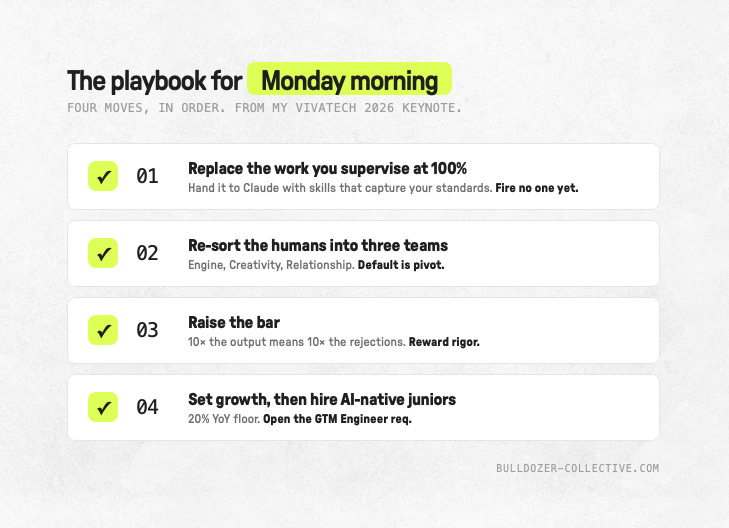
The playbook. Four moves, in order.
1. Replace the work you supervise at 100%. Every brief you re-edit, every report you proof. Hand it to Claude with skills that capture your standards: your banned words, your examples of great. The content system I broke down two weeks ago is this move, executed. Fire no one yet.
2. Re-sort the humans into the three teams. Engine, Creativity, Relationship. Map every freed-up person to one. Default is pivot. The exit conversation, if there is one, comes last.
3. Raise the bar. Ten times the output means ten times the rejections. Standards become the bottleneck, so reward rigor in onboarding the way you used to reward volume.
4. Set growth, then hire AI-native juniors. 20% year over year as the floor. Then open the GTM Engineer req and staff the bench you’ll need in 2030.
Be the leader who’s hiring
Two playbooks share step one: replace the supervised work.
The fragile one then fires the humans, books the cost win, and cracks in year seven.
The anti-fragile one re-sorts the team, keeps planting juniors, and grows.
By 2030 the first is bidding for seniors in a market it helped empty. Korn Ferry already priced that auction: $11,164 a year of premium per skilled worker.
The people being hired are not the people being fired. Be the leader who’s hiring.
(Your CFO already ran the cost tab. Send them this one.)
Let’s grow 👊
— Jordan
Great framing. One thing missing from the "re-sort, raise, grow" playbook is onboarding. The reason most companies avoid hiring juniors is also bandwidth. Mentorship requires senior brain time that nobody has anymore. So you get a false choice, either you hire juniors and expect autonomy they don't have yet, or you just don't hire them at all.
AI breaks that constraint. We have the ability to build onboarding experiences that function like a product with structured, scalable, context-rich experience. A junior today can be handed a system that encodes your standards, your past decisions, your reasoning, and let seniors be part of the loop. For me the antifragile org is unlocked by building the infrastructure infused in buisiness context knowledge, thus everyone benefits, and let juniors thrive without draining your seniors.