


This edition of Bullish kicks off a series: the behind-the-scenes of how we actually use AI for revenue at Bulldozer. We start with marketing, and show you how we built our content operation with Claude Code.
You’re reading the machine
This newsletter was produced by the system it describes.
So was every LinkedIn post, every tweet, every SEO brief we shipped this week.
One person. One weekly routine. We call it /week.
It opens on a Monday, and by lunch a full week of content exists: personal and company LinkedIn posts (one a day), this newsletter, SEO pages, the visuals, the tweets. And when there’s a podcast episode, a webinar, or a physical event in the pipeline, the full sequence that comes with it: emails, reminders, announcements.
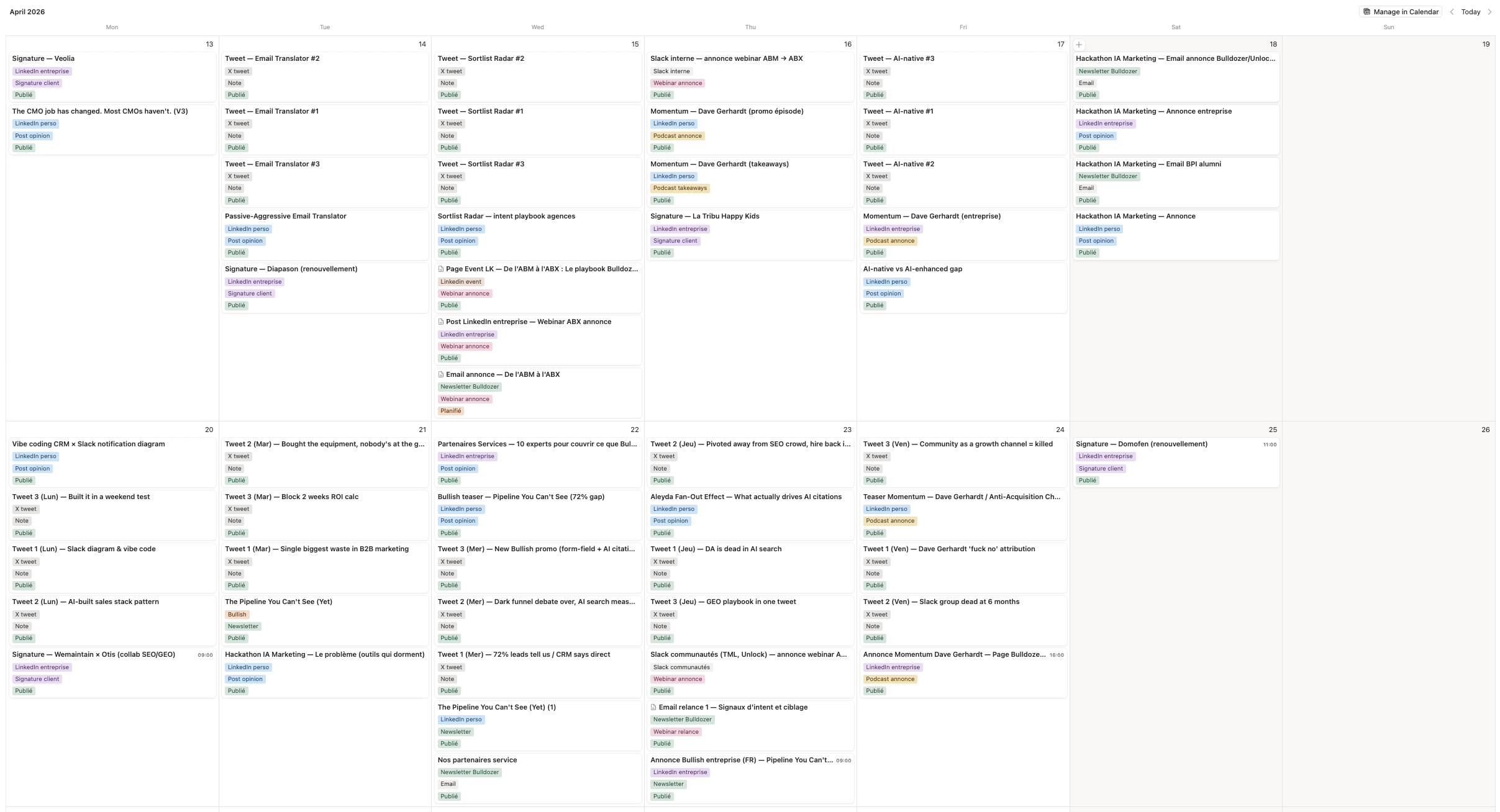
The part the hype skips: when I produce with AI, the ideas, the angles, the direction stay mine. Claude doesn’t replace my thinking. It challenges it, it organizes it, it keeps the quality bar consistent across every format.
The output sounds like me for a reason. I wrote more than 1,000 LinkedIn posts and hundreds of newsletters by hand before any of this existed. The model didn’t hand me a voice. It learned mine. People still recognize my tone, because it is my tone.
The input is human. The final read is human.
The machine makes the work faster, not the thinking.
Now the architecture, because that’s the whole point.
We didn’t write one giant prompt. We split the content operation into dozens of small skills and slash commands, each with one precise job:
one writes the newsletter
one turns a transcript into posts
one drafts the signature post for a new client
one handles SEO briefs
32 skills, 29 commands, at last count.
On top of them sits one meta command. When we run /week, Claude doesn’t wait for instructions. It runs the interview:
Is there a newsletter this week?
A podcast episode? If yes, the transcript?
A new client to announce? A webinar to push?
It asks, we answer, it routes each job to the right skill. The system is a conversation, not a button. That part took the longest to get right, and it’s the part nobody shows you.
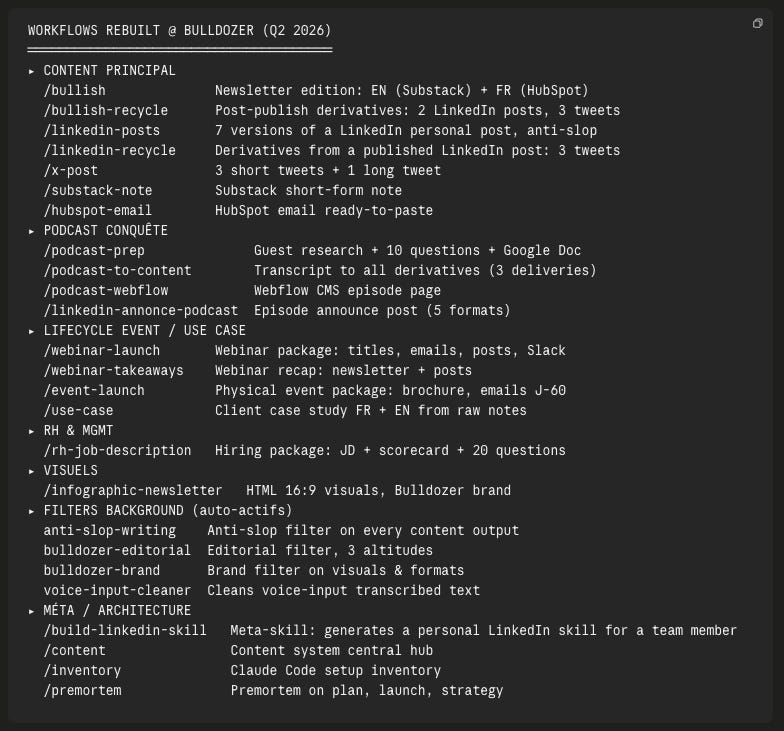
One input feeds many formats. A podcast becomes a newsletter, the newsletter becomes LinkedIn posts, a post becomes tweets.
Text is the easy part. Most of it gets drafted, checked against our brand and anti-slop rules, and queued.
Visuals plug in at specific points only: the newsletter, the LinkedIn infographics, the webinar thumbnails. Everywhere else the post is text, and we don’t force an image where it doesn’t belong.
Yes, a human still reads everything before it ships. And this human is me ✌️
The shift for a CMO: the question stopped being “how many marketers do I have.” It became “what system do they run.”
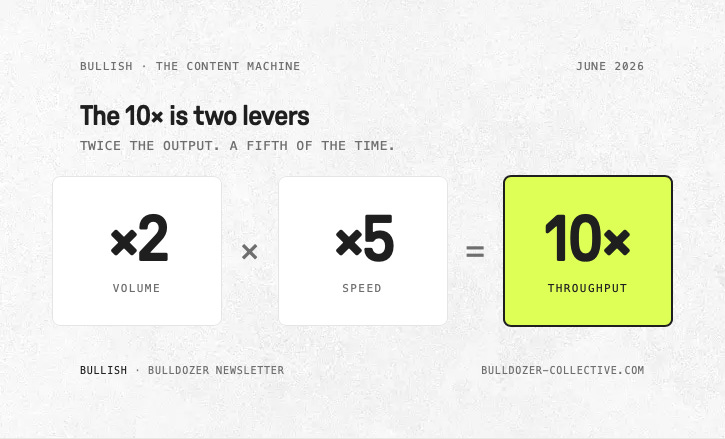
Two times the output, one fifth of the time
Before the system, we produced about half of what we produce today, and a single week of it took two and a half days.
Now that same week takes half a day, and we ship twice the volume.
Stack the two together and you land on a tenfold jump in throughput: twice the output, in a fifth of the time 😵💫
The honest caveat: that 10x is on production, not on judgment. The system writes faster. It doesn’t decide what’s worth saying. That still sits with a human.
What actually breaks when you wire AI into content
Three things we learned the hard way.
1️⃣ Sequencing is the real bottleneck.
Writing was never the hard part. The model drafts fine.
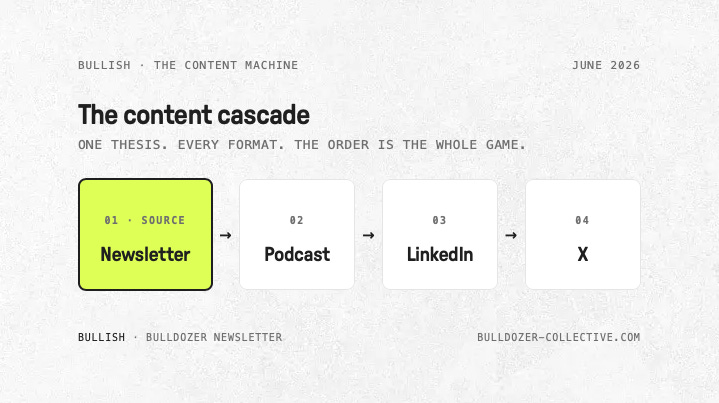
One piece feeds several formats, and the order is everything. The newsletter sets the week’s thesis. The podcast deepens it. LinkedIn carries it. X sharpens it.
Get the order wrong and the whole week turns into rework. We iterated for months before the cascade settled. Now that order is baked into the meta command: the newsletter first, then the podcast, then the rest.
2️⃣ Visuals are still the weak link.
Watch a Gemini or OpenAI demo and you’d bet images are the first thing to fall into place. In production it’s the opposite.
Today our visual layer is a mix: some made with Nano Banana (Gemini), some built directly in responsive HTML, which lets us play with formats. Outside templated assets like webinar thumbnails, it’s still shaky.
The demos won’t tell you that. We will.
3️⃣ The human role moves up, not out.
When production becomes a system, the person on content stops drafting and starts directing: owning the cascade, supervising tone, choosing the angle.
Our content manager just moved into field marketing. The work that compresses into a system went to the system. The work that doesn’t compress, judgment and taste and relationships, went to the human.
How to build your own content machine
1. Treat content as a system, not a pile of tasks. One input, every format.
2. Split the operation into sub-tasks. Each one becomes a named command you can run, fix, and improve on its own. We covered the method for splitting work into sub-tasks in our previous edition, so we won’t repeat it here.
3. Put a sparring partner on top. A meta command that interviews you and routes the work beats a folder of clever prompts.
4. Design the cascade before you grow volume. The edge is in the sequence, not the tool.
5. The stack: Claude Code, 32 skills, 29 slash commands, a memory file, and about a dozen MCP connections (HubSpot, Notion, Buffer, Webflow, Ahrefs, GA4, Search Console, Slack, Gmail, Canva).
6. Guard quality. Every output passes an anti-slop filter before it ships. We keep the list of what counts as slop public, here: Wikipedia: Signs of AI writing. Speed is worthless if the copy reads like a robot.
7. Keep a human on visuals. Templatize what works, hand-build the rest. Don’t pretend it’s solved.
Build the system or staff the backlog
You can keep hiring to produce more content. Or you can build the system, ship ten times the throughput, and move your best people to the work a system can’t do.
One of those choices compounds. The other just grows the payroll.
Let’s grow 👊
— Jordan