


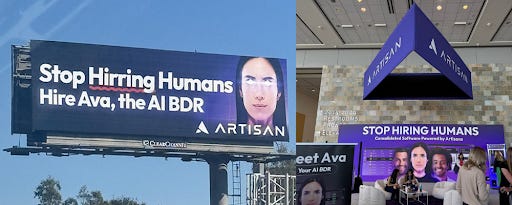
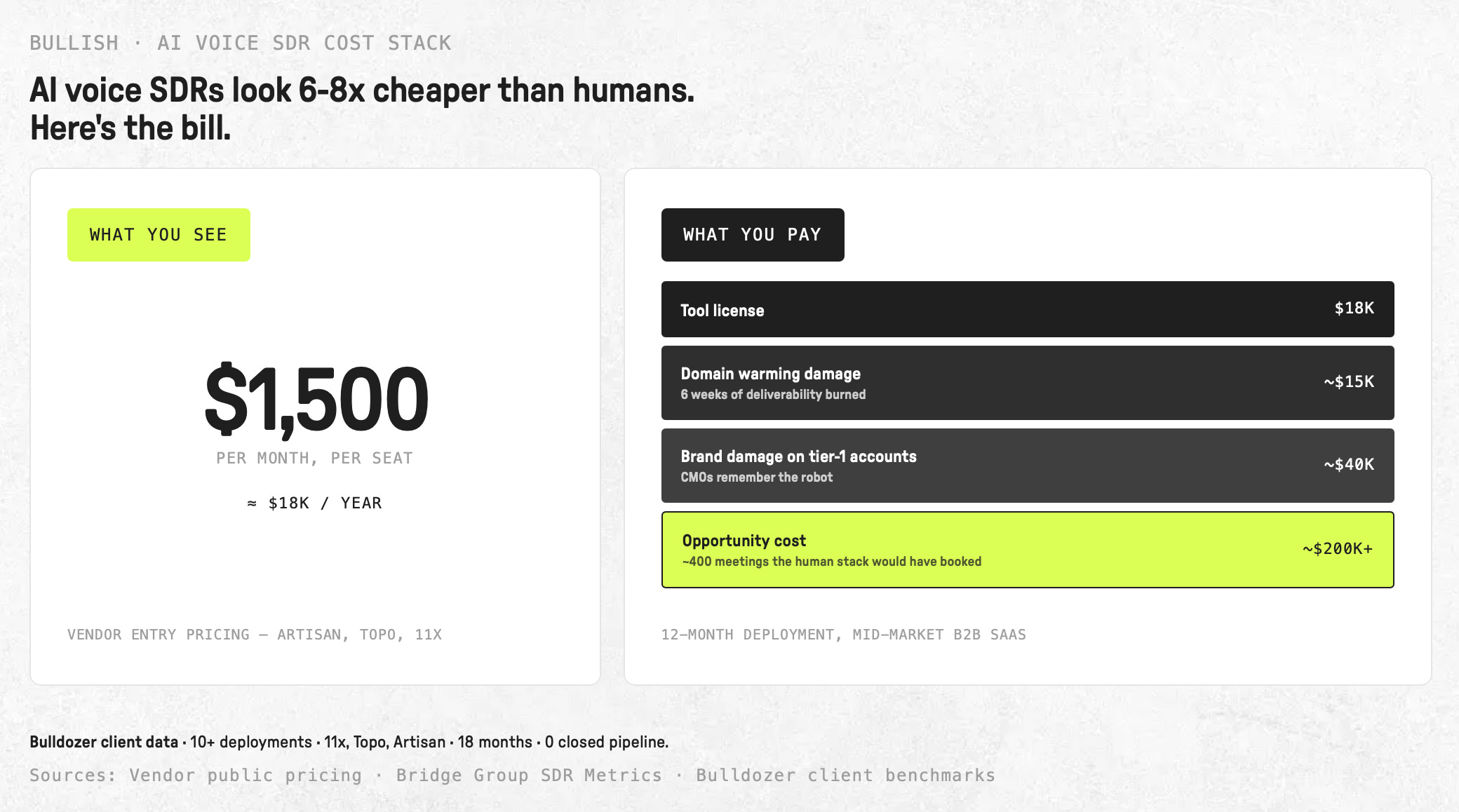
In late October 2024, Artisan blanketed San Francisco with billboards reading 'Stop hiring humans' — bus shelters, freeway 101, even the route in from SFO. A month earlier, 11x had raised $50M from a16z at a $350M post — on top of a $24M Series A from Benchmark earlier that year. The vendor math looked clean: AI seats at $1,500-2,000/month, versus a fully loaded human SDR at $120-150K/year in the US. Roughly 6-8x cheaper.
Across 10+ B2B clients between 2024 and 2026, on 11x, Topo and Artisan, with 10,000+ voice calls placed:
Zero. Pipeline. Closed.
That’s not “below benchmark.” That’s not “needs more time.” That’s the bill.
The Information reported in February 2025 that 11x customers were churning inside 90 days of six-figure contracts. Topo quietly stopped calling itself an “AI SDR” mid-2025. The receipts came in. They’re expensive.
The 30x discount that lied
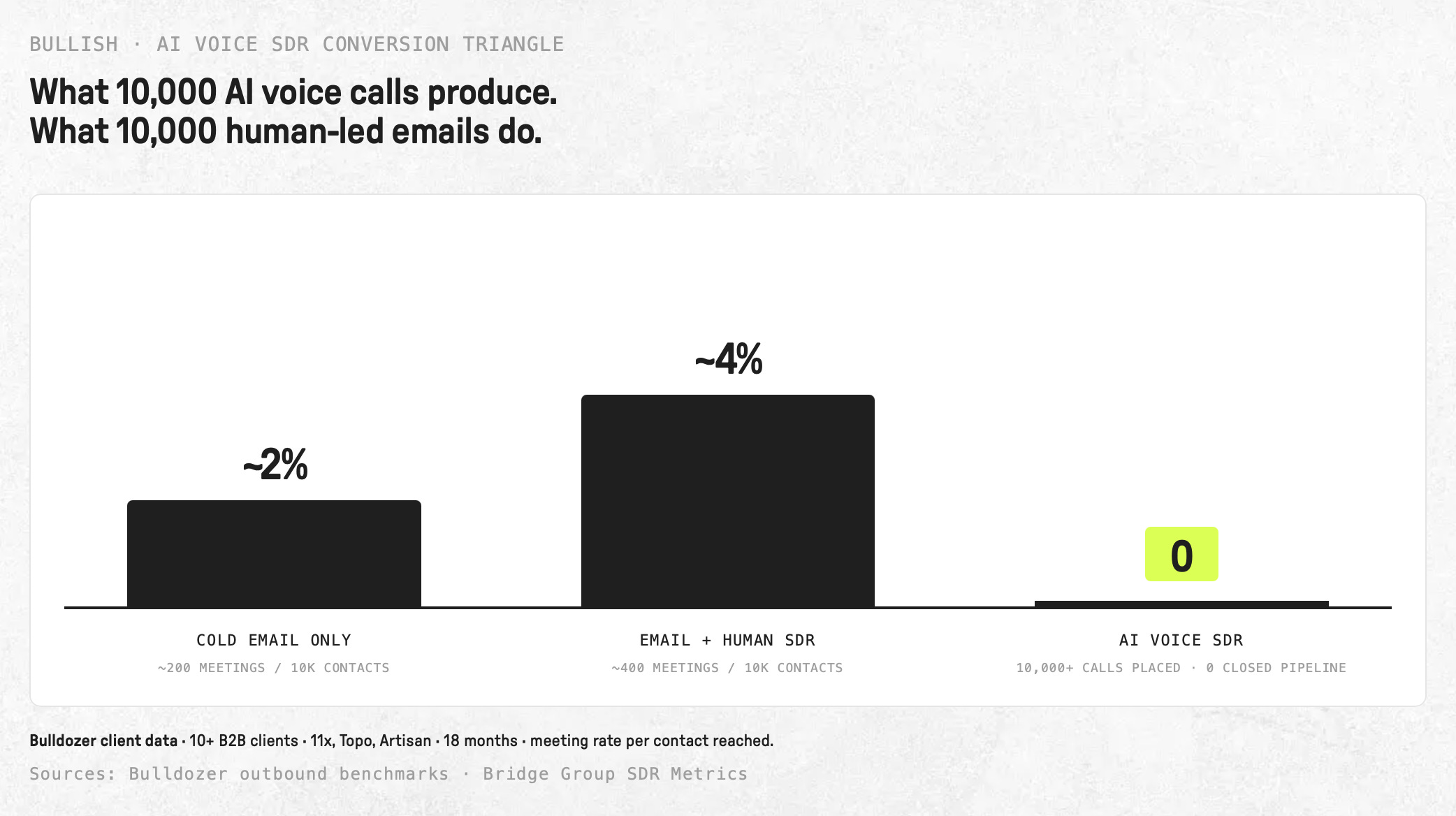
The triangle is short. On a Bulldozer-grade cold email setup — premium ICP, tight list, hand-written copy — we book meetings at roughly 2-3% of emails sent. Add a human SDR on follow-up to the same list and the meeting rate doubles to ~5%. Run the same 10,000 contacts through an AI voice SDR and you book… well, we did, repeatedly.
Zero pipeline.
Not 0.4%. Not 0.04%. Zero.
Math nerds will appreciate that “infinite worse” is mathematically correct when the denominator is zero.
So the apparent ROI was only ever the apparent half. Artisan’s entry pricing sits around $1,500/mo. 11x mid-market deals run $36K-$120K ARR. The Bridge Group benchmark for a fully loaded human SDR is $120K-$150K in the US, €75K-€90K in France. On the spreadsheet, AI looked 30x cheaper.
What the spreadsheet didn’t carry was everything else. Domain warming damage that bled into the email channel for weeks. Brand carryover damage on tier-1 accounts where a target’s CMO heard our pitch from a robot and remembered. The roughly 400 meetings we would have booked the human way on the same volume of contacts. Never booked.
Vendors quote calls placed. They quote meetings booked. They don’t quote meetings held times stage-2 conversion times closed-won attribution. That column is missing from every AI SDR dashboard for a reason.
Why every voice deployment broke
Three patterns. Same three, every time.
Pattern 1 — Reply quality. Prospects spot the voice in the first five seconds. They don’t say “stop calling.” They quietly add the brand to a mental blacklist and move on. The damage is invisible until the next quarter when the same accounts won’t take a real call from a real rep. As John Short framed it: outbound is humans having a conversation. Removing the human doesn’t compress the conversation, it eliminates it.
Pattern 2 — The deliverability tax, voice edition. Carriers spam-flag the number. The number burns. The next number burns faster. Carrier reputation systems are now sophisticated enough to fingerprint AI voice patterns across providers, which means burning numbers at one vendor follows you to the next. And the spillover lands on the email channel too — a deliverability score earned back over six weeks of careful warming gets torched in two weeks of AI calling.
Pattern 3 — Buyer-side AI is real. Seller-side AI doesn’t fit yet. Dave Gerhardt put this cleanly on Momentum: “Until my AI agent is doing research for me and buying on my behalf and is exclusively talking to your AI agent, humans are still involved in the buying process.” Today, the buying journey still routes through a human. Replacing the seller in that conversation means showing up to a meeting that never happens.
Trying to scale outbound with AI voice today is like training a kid to be an SDR. The kid can learn. The kid is not ready to call your top 200 accounts on Tuesday.
Some of the AI demos are good. So is a chess prodigy at eight. You still don’t put him in the CFO seat.
Where AI still earns a budget
The voice failed. The wider stack didn’t. Six moves we kept after 18 months.
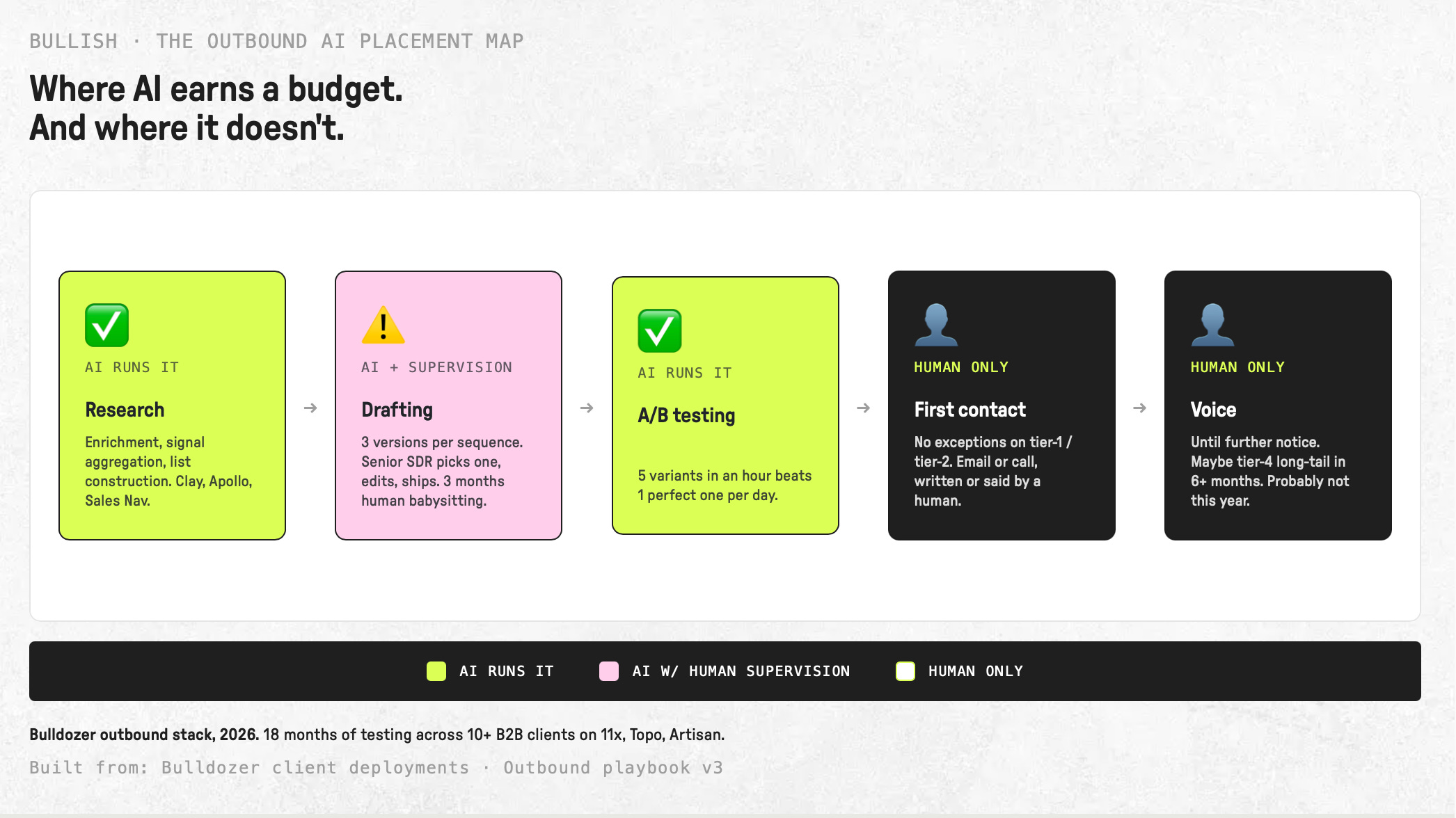
1. Hand AI the research. Keep the message human. Clay or equivalent for enrichment, signal aggregation, list construction. Humans write the copy. Tools that pulled their weight across our deployments: Clay, lemlist, LinkedIn Sales Navigator.
2. AI on prep, drafts, and variants — never on first contact. GPT and Claude generate three versions of a sequence before lunch. A senior SDR picks the one that sounds like them, edits, ships. Five tested variants per hour beats one perfect one per day.
3. Three months of heavy human supervision. Minimum. Treat the AI tool like onboarding a promising intern. Roughly 80% of outputs need editing in month one, 50% in month two, 30% in month three. If you cannot afford the editor’s hours, you cannot afford the AI.
If “three months of human babysitting” wasn’t in the demo, that’s because it wasn’t in the deck.
4. Voice stays human until further notice. No exceptions on tier-1 or tier-2 accounts. Maybe — maybe — AI on tier-4 long-tail follow-up after six months of fine-tuning on your specific call recordings. Probably not, this year.
5. Track the metric that closes deals. Not calls placed. Not meetings booked. Meetings held × stage-2 conversion × closed-won attribution. AI dashboards omit the part of the funnel where the meeting doesn’t happen, and that’s the part of the funnel where the truth lives.
6. Read the vendor pivots. When Topo stopped calling itself an “AI SDR” and started calling itself an “AI research agent” mid-2025, that wasn’t a marketing tweak. That was the market correcting the autonomous-outbound narrative in real time. Listen.
Two choices for 2026
Option one: keep the seat. Pay $1,500-$10,000/month for the AI voice SDR. Watch the domain reputation collapse across the next 18 months. Read another LinkedIn post about how AI is replacing your team.
Option two: pay the humans. Use AI on the work that doesn’t need a voice — research, drafts, variants. Three months of supervision, then maybe a fourth. Wait for the tools to actually mature.
One option saves you €90K this year. The other saves you three years of pipeline.
Pick. (And if you pick the first one, please don’t put me on your call list 🙃)
Let’s grow 👊
— Jordan
Article très instructif et lourd de sens, merci (qui fait également du bien à lire en ce moment) !