


I’ve been posting on LinkedIn for 6 years now.
5M+ reach per year on average. My profile has been Bulldozer’s #1 acquisition channel in 2023, 2024, 2025 (≈500 leads) and generated 10M€+ in revenue in total.
But here’s what matters more: the content gave me credibility with prospects, peers, and our team. Day-to-day, it helps me close deals faster and land exceptional guests for my podcast.
Less than 1% of LinkedIn users post regularly. I get why.
Because of this:

Today I’ll explain how I use LinkedIn – far from the pseudo-inspirational, moralizing garbage you see in your feed.
A practical guide that will, I hope, get you posting regularly and raising the bar on the platform.
LinkedIn is the best channel for demand gen. Period.
Before we talk tactics, let’s talk strategy.
You already know the dark funnel problem. Gartner says only 5% of your TAM is in-market right now. Everyone’s fighting over that 5% – CACs explode, boards get nervous, you lose.
The 95% sitting out-of-market? They’re researching. Reading. Watching. Building mental models about who solves problems like theirs.
LinkedIn is where B2B buyers build those models.
Your prospects aren’t reading your blog. They’re scrolling LinkedIn during their commute, between meetings, while pretending to pay attention to that all-hands call.
When you post consistently, you’re doing three things:
Building top-of-mind presence with the 95% before they enter buying mode
Reducing sales cycle length because prospects arrive pre-educated and trusting you
Increasing close rates because you’ve already demonstrated expertise
At Bulldozer, we track this. Deals that come through my LinkedIn profile:
Close 40% faster than cold outbound
Have 2.3x higher ACV than paid channels
Convert demo → closed-won at 31% vs 18% company average
Why? Because the “sale” happened over months of reading my posts. The demo is just paperwork.
This is demand generation, not lead generation.
You’re not capturing intent. You’re creating it.
Now let’s talk about how to do this without sounding like an AI thought leader.
#1. Optimize your “landing page”
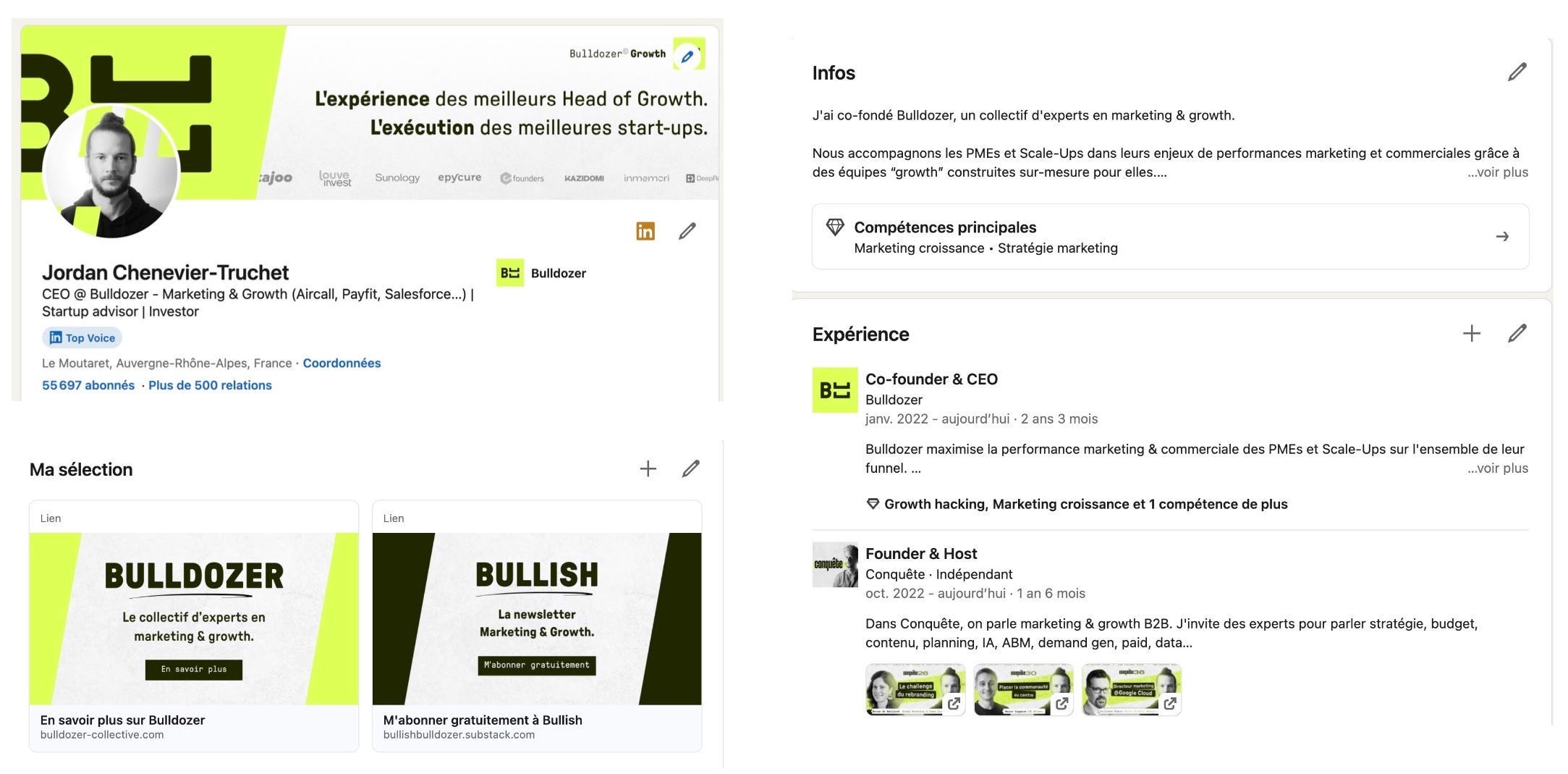
Beyond the feed, your profile is LinkedIn’s hub. Think of it as a personal landing page. Optimize it the same way you’d optimize a website.
Four sections matter:
Header – banner, photo, headline
Featured – pin useful links or top posts
About – your bio
Experience – professional history
Seems obvious. But 30 minutes updating these can improve your credibility (and conversion) significantly.
But the real topic isn’t profile optimization.
It’s content creation. That’s where it gets hard.
#2. The 5 commandments
Imposter syndrome. Lack of ideas. Fear of judgment. Every excuse exists for not posting.
To help, follow these rules:
1. Be honest about your goals
Nothing wrong with wanting likes, followers, or impressing people. But that probably won’t bring you good leads.
I’ve tested a lot on this platform. I’ve noticed “reach” attracts small businesses – makes sense since they outnumber large ones.
Which brings us to commandment #2...
2. Know your audience
You don’t need to pander to create engagement.
You can get high engagement on BOFU topics. The key is finding subjects that make your audience react, even when technical.
Example with this post (which I honestly didn’t understand):
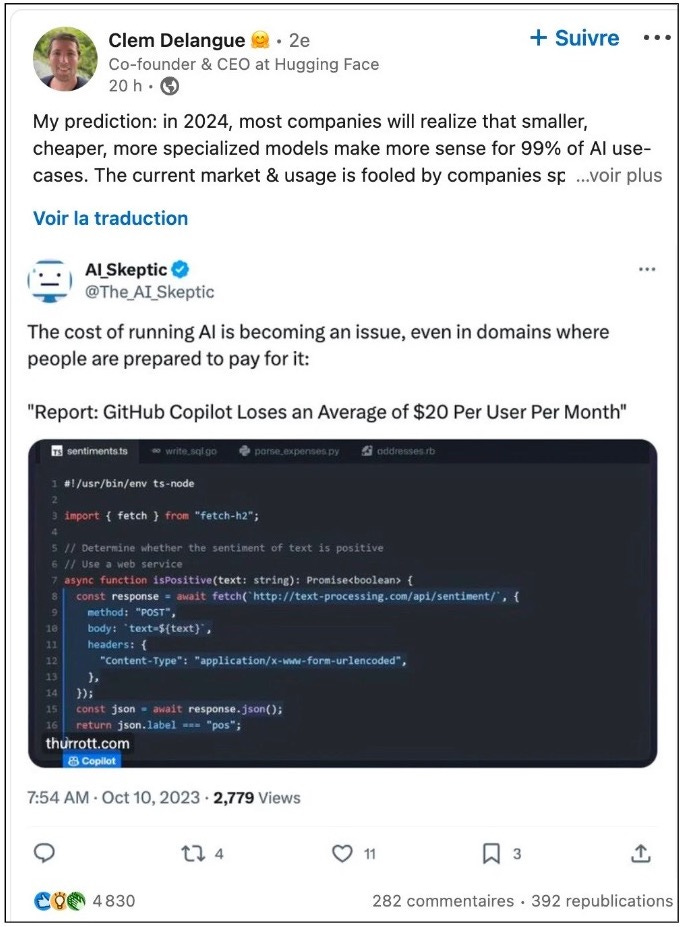
I know, marketing 101. But worth repeating.
3. Give something personal
Probably the hardest, but talking about who you are outside work creates strong hooks with your audience. It gives you ice-breakers, builds connection, breaks the corporate wall.
Example: At the bottom of my bio, I mention I live in the mountains, love street food, practice MMA, and support legalizing psychedelics → Every week I get messages (sometimes hilarious) about one of these topics.
4. Work your hooks
Simple math: unread hook = unread post.
I spend 80% of my writing effort on these few words/sentences.
You need to grab attention without giving everything away, but without overpromising either (the famous “clickbait” hooks). A balancing act that takes many iterations to find the right tipping point.
Thibault Louis talks about “the 75% rule” – I find it spot-on.
Example with this hook from Jason Lemkin:
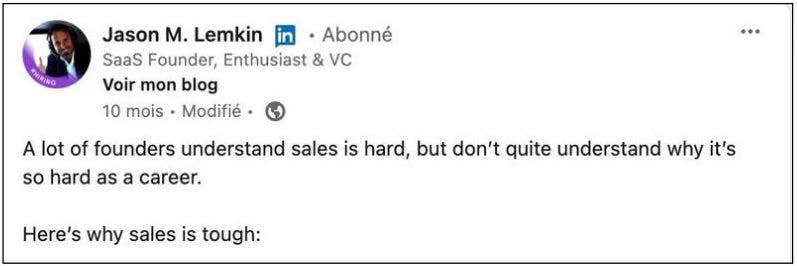
You get 75% of the information (the topic, his opinion) but you’re missing the 25% that makes you understand it.
5. Ride the waves
It’s common to observe “trends” on the platform. Topics or post formats that perform particularly well for a period.
We’ve had ChatGPT posts, founder stories, infographics, etc.
If it makes sense for you and you nail the timing, I recommend going all-in.
That’s what I did in 2024 with these two posts:
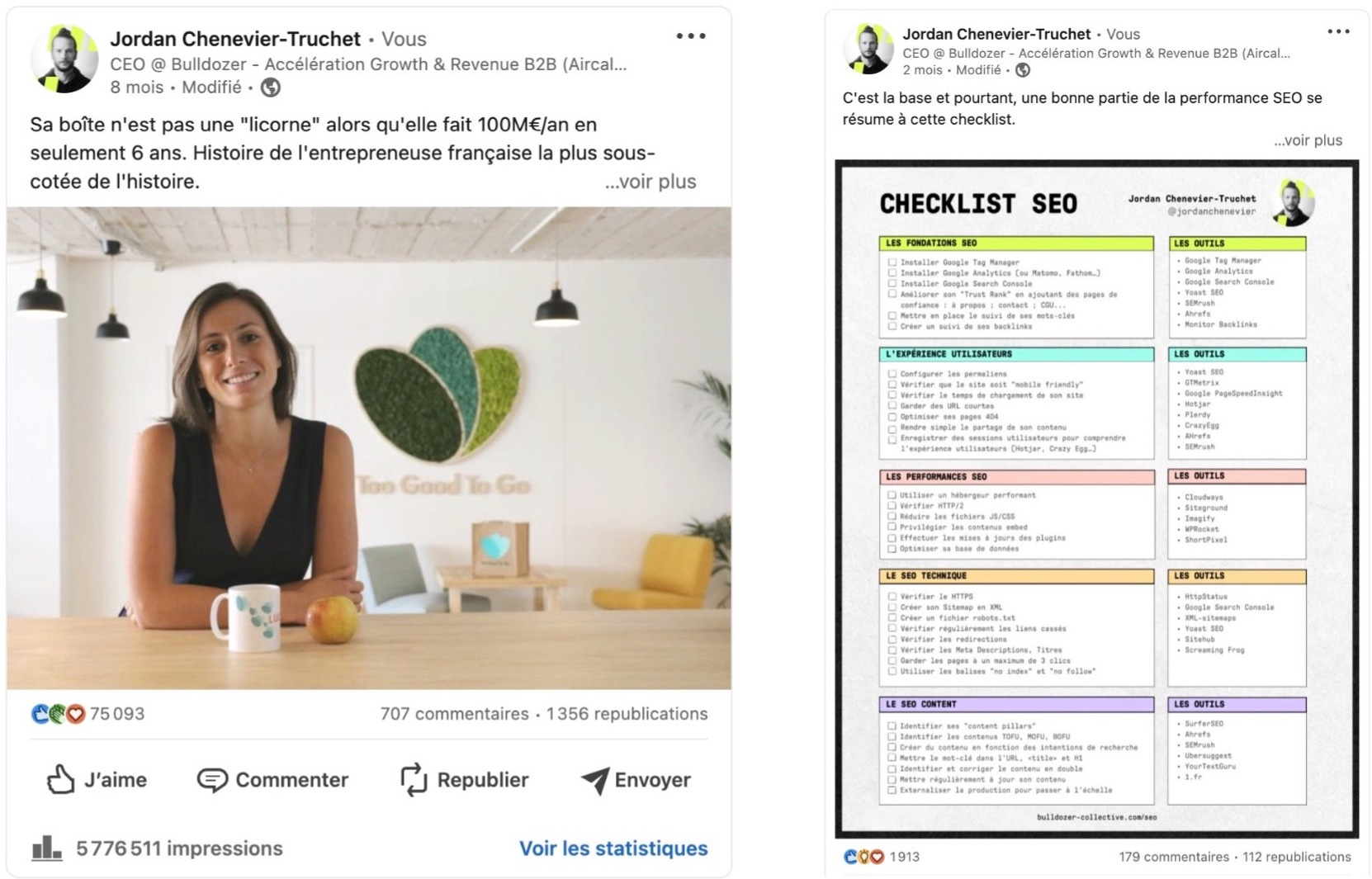
Take note of the performance...
#3. You are a character.
Now you need to post.
Contrary to what you think, you don’t need to be in the top 1% of your field to add value to your peers.
If you want to learn piano tomorrow by watching YouTube videos, you’re much more likely to watch tutorials from someone 2-3 levels above you than a breakdown of a Mozart piece by Lang Lang.
That’s why I recommend rotating between 3 roles:
Leader. You position yourself as a “leader” on your topic and share insights others don’t have – data, contrarian opinions, methods... It’s the role everyone dreams of, but it’s the hardest to maintain (and not always the most interesting).
Discoverer. You’re not the “leader” but want to become one. So you go discover what’s working best and document it. You share your experiments.
Reporter. Like a journalist, you interview experts in your field, extract lessons, and share them with the world. That’s what I do with the Conquête podcast.
The “Discoverer” and “Reporter” roles require some humility (which doesn’t hurt) and people love them. I promise.
#4. Repurpose your content
You’ve posted! Congrats 👏
Now you need to increase cadence. An easy way: repurpose your content. Take your topic and identify every way to talk about it.
Take “SEO backlinks” as an example. Different approaches:
Actionable. How to find free backlinks?
Inspirational. Bulldozer: 0 to 118 backlinks in under 90 days.
Analytical. How Google prevents you from getting backlinks?
X vs Y. Free vs paid backlinks: performance difference?
List. 25 free sites to get backlinks
Tips, myths, stats, hacks, trends, quotes, examples...
You have 1,000 ways to approach 1 topic. Use them.
#5. Random advice (that’s actually critical)
Don’t be fooled – these are simple tips but extremely important:
1 post = 1 idea
Thesis, antithesis, synthesis
Being understood > sounding smart
Use humor / memes. Everyone likes to laugh.
Avoid pandering unless it’s a battle you’re ready to lose
Clean your feed regularly
Study the best
Q&A
To finish, I’ll answer the 3 questions I get most about LinkedIn.
Feel free to reply to this email with questions. Happy to answer.
→ Do you get help producing content?
Writing-wise, I write all my posts myself. But Charlotte and Maëlie help with all visual creation (infographics, carousels, etc.).
We also work with Florent for video production.
→ Do you prepare posts in advance?
No. I write my post in the morning when I open my laptop. I could build a “stock” ahead of time, but I like the idea of writing a bit each day.
That said, there are days I know what I’ll talk about. i.e Thursday is reserved for announcing new podcast episodes.
→ Do you use AI to help?
I’ve found my tone, my style, and I believe no one can be “me” but AI helps to write the first draft.
Bonus : how this connects to your pipeline
Let me close with metrics that matter to you as a CMO.
Tracking LinkedIn’s revenue impact:
We treat LinkedIn profile performance like any channel:
Source attribution in CRM (tag: “LinkedIn Organic”)
Track: First touch, last touch, multi-touch
Compare: CAC, sales cycle length, close rate, ACV
What we see consistently:
CAC: 60-70% lower than paid social
Sales cycle: 30-40% shorter than cold outbound
Close rate: 1.5-2x higher than other organic channels
ACV: 2-3x higher (senior buyers engage)
Why this works:
You’re not interrupting. You’re educating during the research phase. By the time they book a demo, they’ve consumed 10-20 pieces of your content. They trust you. They’ve self-qualified.
This is the dark funnel illuminated.
When a CMO asks “how do I prove content ROI?” I always ask “how do you know me?” and then she smiles. Track the channel like you’d track anything else. The attribution isn’t perfect, but it’s good enough to make budget decisions.
One warning: This takes 6-12 months to compound. If your board wants results in Q2, this isn’t the play. But if you’re building for 2026-2027, start now.
That’s it.
Happy to answer questions.
Let’s grow 👊
— Jordan