


Happy 2026 🥳
This year, I’m not wishing you “success” or “growth” or whatever gurus are posting with sparkle emojis.
I’m wishing you clarity. On what actually moves revenue. On what AI can and can’t replace. On where to focus when everyone else is chasing “the new thing”.
Starting with this: stop fighting over the same 5% of buyers.
Best wishes, and thank you for reading.
$600 cost-per-lead. Up from $200 eighteen months ago.
You’ve got better AI. Better optimization. But worse results?
The math doesn’t make sense until you realize: you’re not competing with your direct competitors anymore. You’re competing with every B2B company using the same AI tools to chase the same 5-15% of in-market buyers.
In 1966, before marketing automation, before digital advertising, before AI, a copywriter named Eugene Schwartz published a framework that explains exactly why this happens—and what to do about it.
“Breakthrough Advertising” sold for $125—about $1,200 in today’s money. Used copies now go for $800+ on eBay.
Schwartz identified something that most marketers still get wrong 60 years later: you can’t use the same message for someone who’s never heard of your product and someone who’s ready to buy.
He called it the “5 Stages of Awareness”.

This isn’t about romanticizing old-school marketing.
It’s about understanding that AI amplifies strategy—it doesn’t create it.
And right now, most companies are using AI to amplify the wrong strategy.
The math problem AI makes worse
If companies change vendors roughly every 5 years, that’s 20% annually—or about 5% in-market at any given moment. Recent Forrester research puts it higher for some categories (15-20%), but the point stands: at least 85% of your potential market isn’t buying today.
AI-powered lead scoring, intent signals, and predictive analytics are incredible at identifying that 5-15%. They’ve made the entire industry better at finding and targeting in-market buyers.
The problem? Everyone else got the same tools. The competition for that 5-15% went from hand-to-hand combat to nuclear warfare.
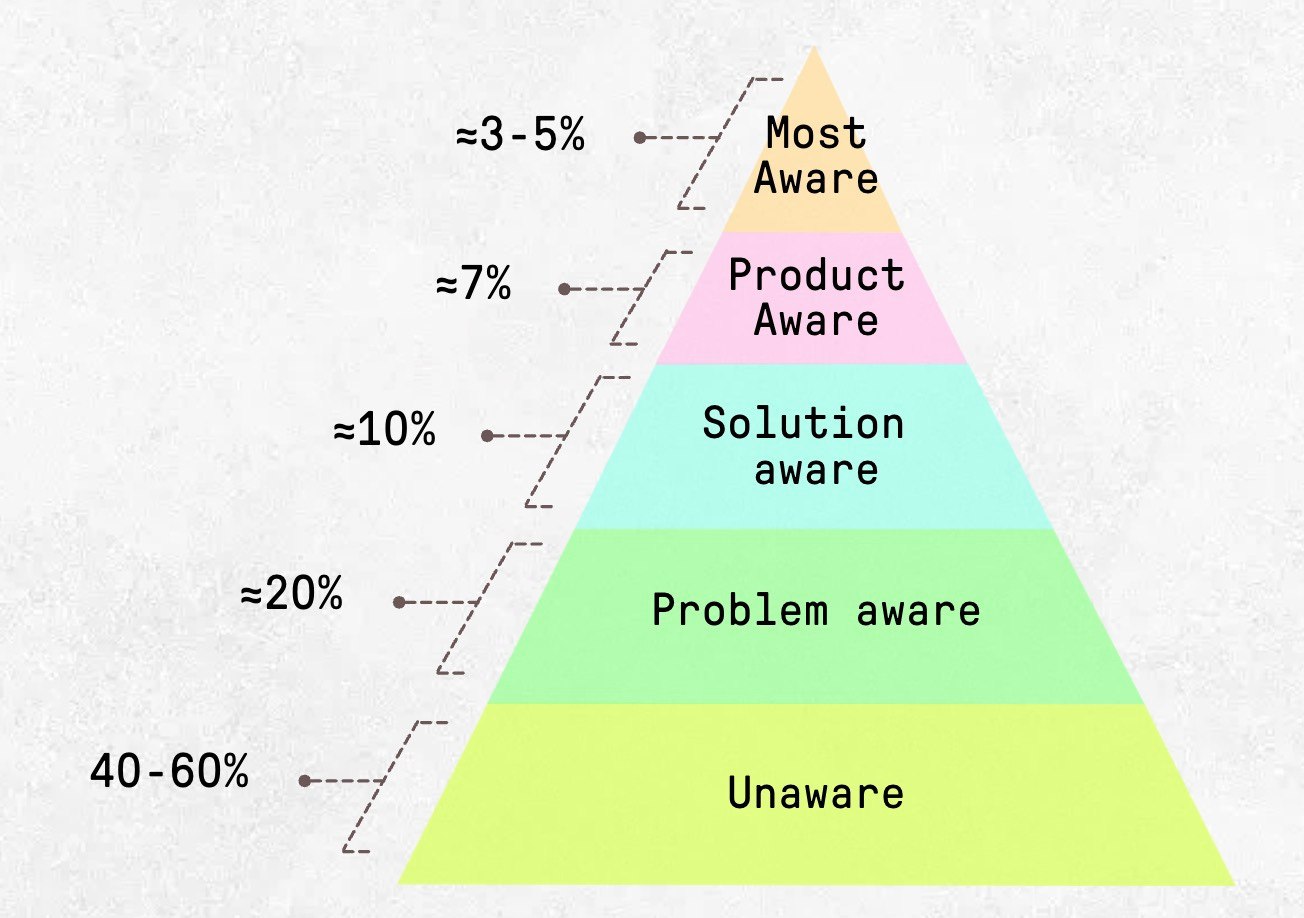
Gartner’s research backs this up—only 5% of your total addressable market is ready to purchase at any given time.
So what’s everyone else doing? They’re distributed across Schwartz’s awareness stages:
40-60% are unaware they even have the problem you solve
~20% are problem-aware but don’t know solutions exist
~10% are solution-aware and researching options
~7% are product-aware and comparing vendors
~3-5% are most-aware and ready to buy
When you’re running AI-optimized Google Search ads, using ChatGPT to write pricing page copy, and A/B testing demo request forms with generative variants, you’re fighting over that 3-7% with every other vendor using the exact same AI tools.
That’s why your CPL went from $200 to $600 in 18 months—despite “AI-powered optimization.”
What AI actually changes
AI will transform how you execute awareness-stage marketing:
Personalized content at scale for different awareness levels
Real-time message testing across segments
Intent signal detection as buyers move between stages
Dynamic creative optimization for cold audiences
AI won’t change why awareness-stage marketing matters:
Humans still need to understand they have a problem before seeking solutions
Buying committees still operate at different awareness levels simultaneously
Trust still takes time to build—you can’t AI your way onto the Day One shortlist
Dark funnel dynamics (Slack conversations, peer recommendations) still account for 70% of the buyer journey
Where the framework breaks
Schwartz was selling books and newsletters through direct mail. One person made one decision.
In B2B, you’ve got buying committees averaging 5-10 people. Your champion might be “most-aware” while the CFO just learned your product category exists last week. Google and Gartner both confirm what we see with clients: B2B buying isn’t linear—it’s a messy loop through problem identification, solution exploration, validation, and consensus-building.
Plus there’s the dark funnel problem. Up to 70% of the buyer journey happens in Slack channels, private communities, and podcast conversations that your attribution software—no matter how AI-enhanced—will never see.
But here’s what still works: the core principle that message sophistication must match buyer awareness.
We’ve tested this across 100+ clients at Bulldozer. When we map content and channel strategy to awareness stages, we consistently see improved performance at every funnel level—ads, landing pages, nurture sequences, the works. AI made the execution faster. It didn’t change the underlying strategy.
The messaging pyramid
After running these tests, we built what we call the Messaging Pyramid. It shows which proposition type performs best at each awareness level.
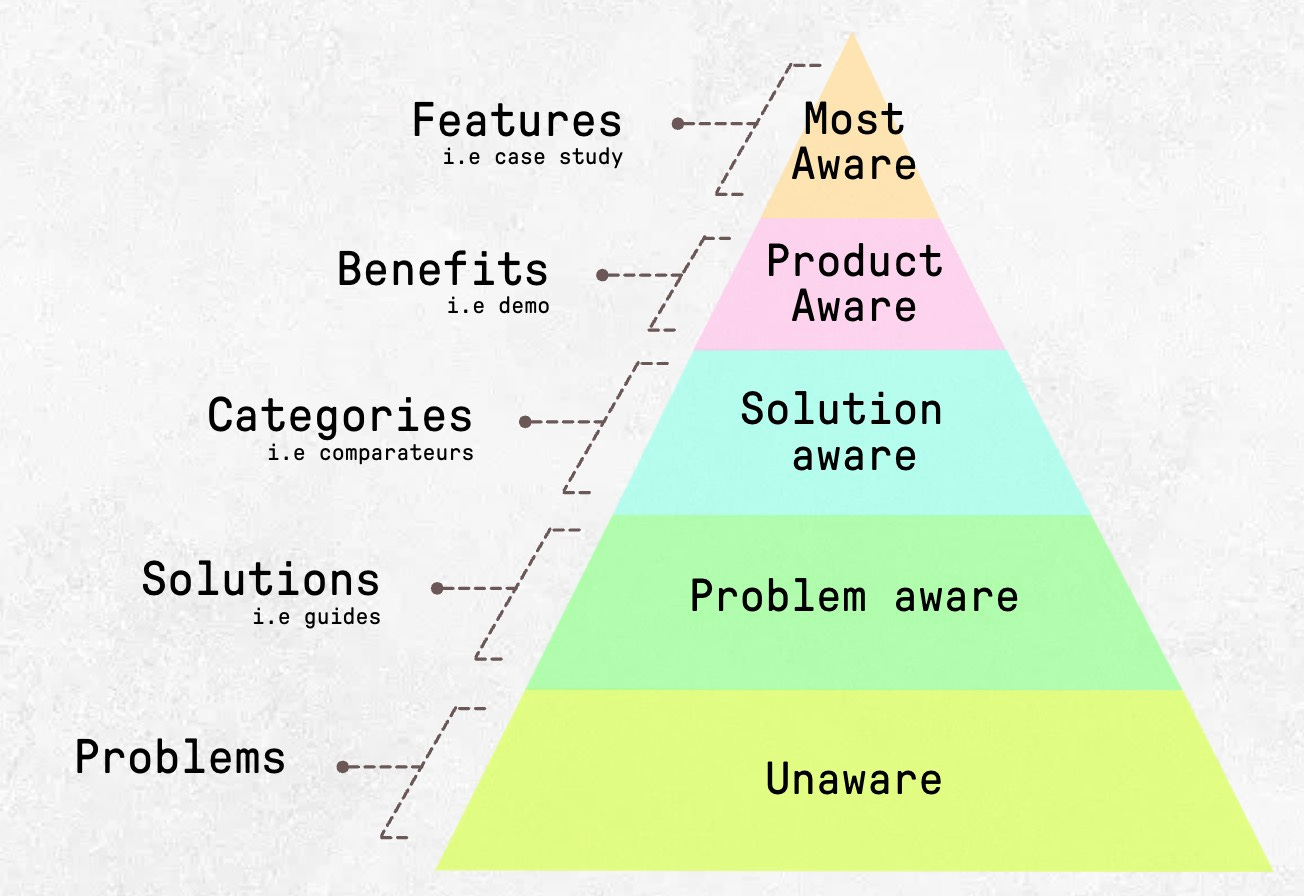
Unaware → Lead with the problem
Example: “Did you know you’re located in a flood zone?” (for flood insurance)
Why it works: They don’t know they need a solution until they know they have a problem
Problem-aware → Lead with the solution category
Example: “The coffee alternative that doesn’t crash” (for yerba mate)
Why it works: They’re searching for ways to solve their known problem
Solution-aware → Lead with the product category
Example: “The 5 best ATS platforms for growing teams”
Why it works: They’re comparing options within a category they understand
Product-aware → Lead with benefits
Example: Store shelf teeth whitening shows “Whiter teeth in 7 days”
Why it works: They’re past education—they just want to know what they get
Most-aware → Lead with features
Example: Camera specs for professional photographers
Why it works: Experts want technical details, not marketing fluff
That “sell benefits not features” advice you’ve heard? It’s only true for one stage (product-aware). For most-aware buyers—the experts—talking about benefits instead of specs makes them think you’re treating them like idiots.
AI can help you generate hundreds of headline variants for each stage. It can’t tell you which stage to target or what type of message resonates there. That’s strategy, not execution.
Channel strategy shifts with awareness
Where you find people changes by awareness level:
Unaware/Problem-aware live on LinkedIn, podcasts, industry publications. They’re not searching for solutions yet because they don’t know they need one. Cold targeting on LinkedIn costs $300-500+ per lead and should never aim for direct conversion—use it to build retargeting audiences.
Solution-aware show up on Google, review sites (G2, Capterra), and comparison content. They’re actively researching.
Product/Most-aware are on demo requests, sales calls, pricing pages, and technical forums. They know what they want—they’re just choosing between options.
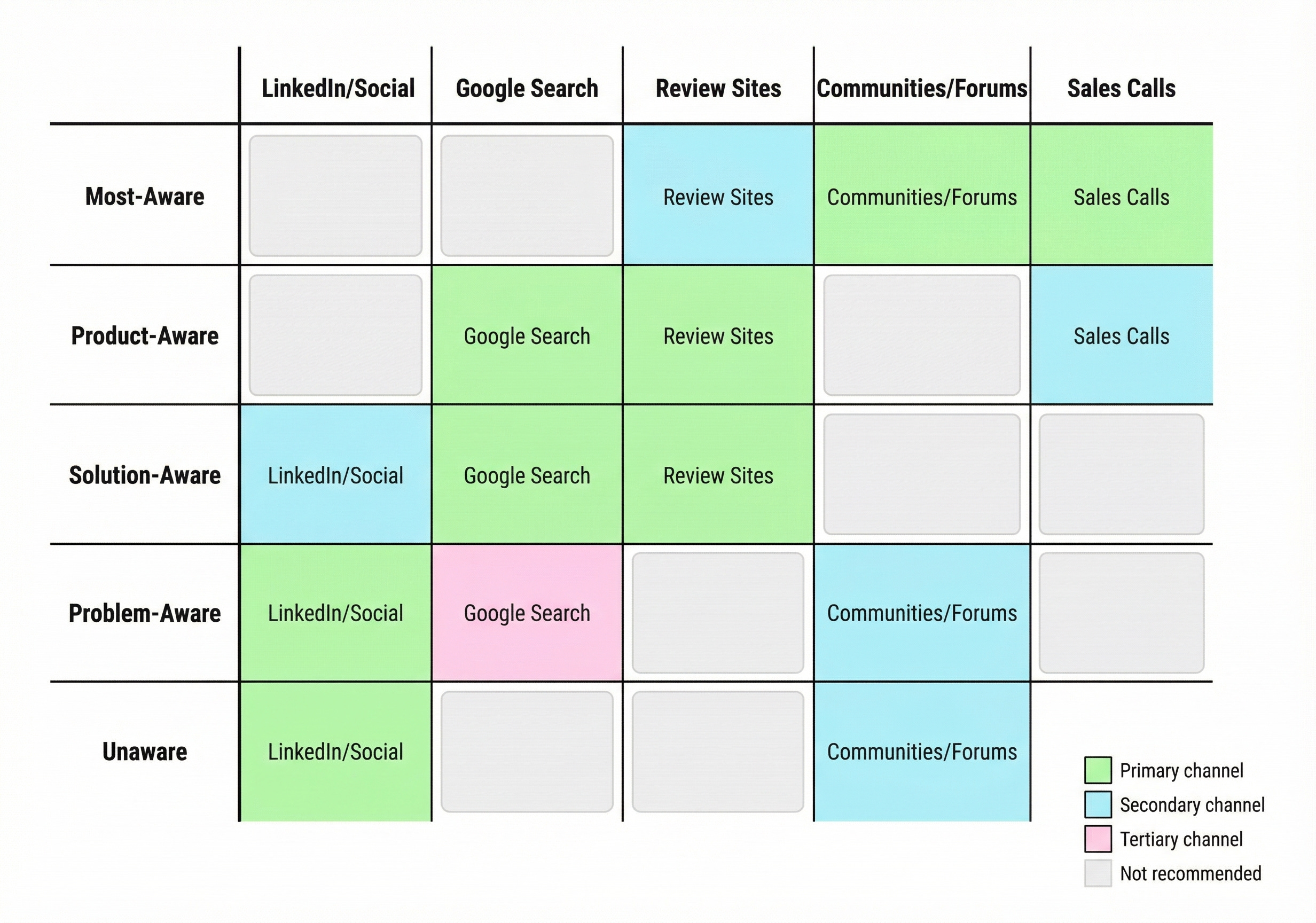
The companies getting this right allocate roughly 60% to demand creation (building awareness) and 40% to demand capture (converting intent). LinkedIn’s data shows audiences seeing both brand and activation messages are 6x more likely to convert.
The AI application that actually matters
Want to know where AI delivers real value in awareness-stage marketing?
Dynamic awareness-level detection: Tools now analyze prospect behavior across channels to infer awareness stage, then serve appropriate content automatically. A prospect watching your “problem education” video gets different follow-up than someone downloading your comparison guide.
Scaled personalization within stages: AI can generate 50 variants of your problem-aware message, each tailored to different industries, company sizes, or pain points—without changing the core “lead with the problem” strategy.
Predictive stage progression: Machine learning models identify which unaware prospects are most likely to move to problem-aware within 90 days, letting you prioritize effort.
Content gap analysis: AI can audit your existing content against awareness stages and identify gaps—”You have 47 pieces for product-aware buyers and 2 for problem-aware.”
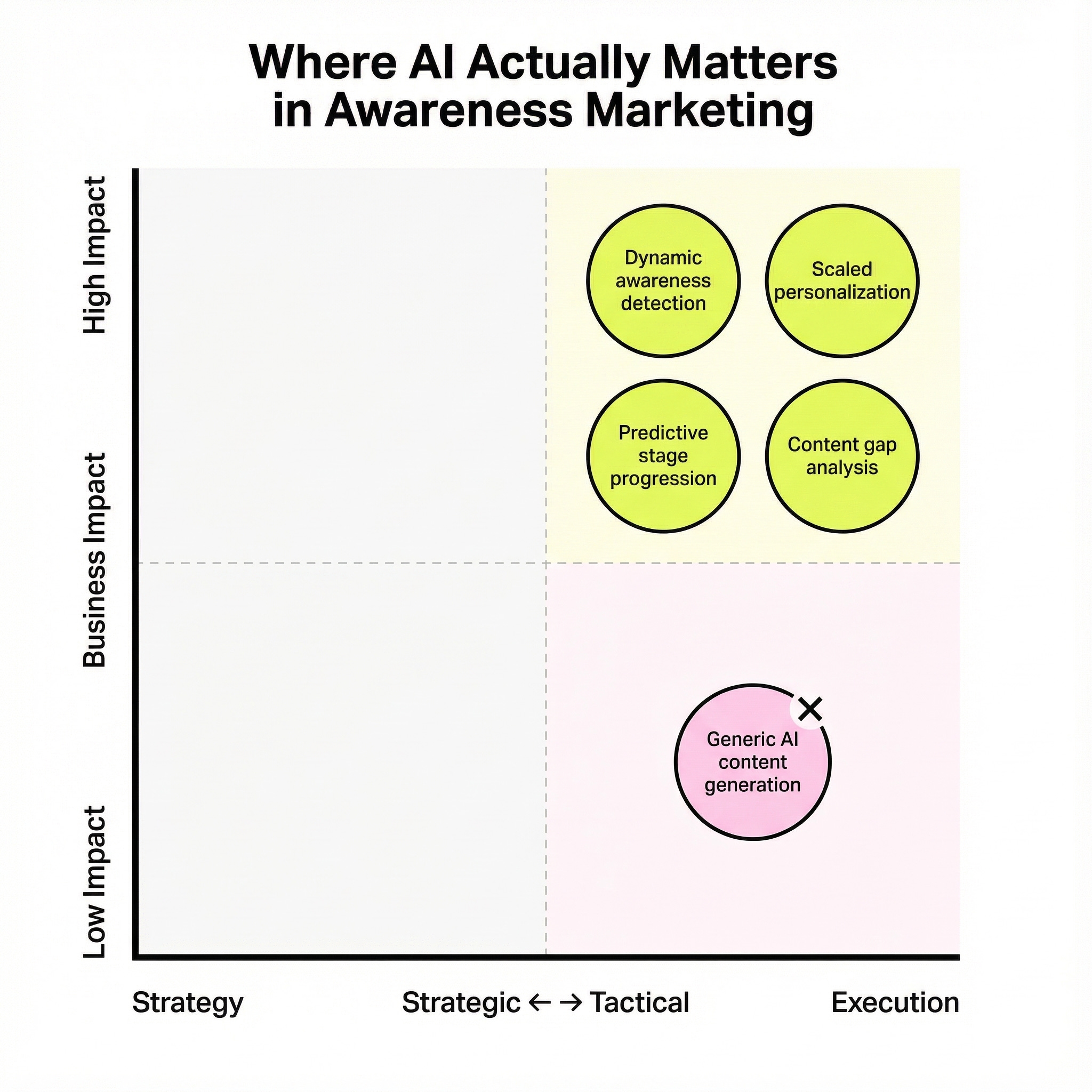
But all of this assumes you’ve mapped your strategy to awareness stages first. AI accelerates the right strategy. It also accelerates the wrong one.
Start bottom-up, then fill gaps
When we diagnose a client’s current strategy, we map everything—content, channels, messaging—against the awareness stages. The pattern is always the same: heavy concentration in solution-aware through most-aware, almost nothing addressing unaware or problem-aware.
That’s actually smart to start. The 5-15% in-market convert faster and prove ROI quickly. But once you’ve saturated that segment, the ceiling appears.
Our recommendation: Start with bottom-of-funnel content (comparison pages, case studies, technical docs), then work upward. You’ll drive revenue faster. But once you hit 70-80% market penetration in the “ready to buy” segment, shift 30-40% of resources to earlier stages.
The data supports this. Companies balancing demand creation with demand capture see 70% higher returns over 12-24 months compared to those doing pure demand capture.
AI doesn’t change this sequence. It just lets you execute it faster once you’ve committed to the strategy.
What this means tomorrow morning
Three things to do this week:
First, audit where your current efforts sit. Pull up your top 10 pieces of content, your main ad campaigns, and your primary channels. Ask: are we addressing unaware? Problem-aware? Or just fighting over the 5-15% already shopping?
Second, identify your gaps. If everything lives in solution-aware through most-aware (like 90% of B2B companies), you’ve found why growth plateaued. No amount of AI optimization will fix a strategy gap.
Third, test one piece of unaware or problem-aware content this month. A LinkedIn video highlighting the problem without pitching your product. A guide addressing the core challenge your category solves. Track it not by immediate conversion, but by retargeting pool growth and influenced pipeline 60-90 days out.
Use AI to create 10 variants of that content across different industries or personas. But don’t use AI to avoid doing the strategic work of identifying which awareness stage to target.
The timeless principle
Marketing technology will keep evolving. In 12 months, we’ll have new AI tools that make today’s capabilities look primitive. The companies using those tools to fight over the same 5-15% will see marginal gains.
The companies using those tools to reach the 85-95% who aren’t shopping today—the unaware and problem-aware majority—will see step-function growth.
The framework is 60 years old. The insight remains timeless: you can’t sell to someone who doesn’t know they have a problem. AI doesn’t change human psychology. It just helps you apply these principles at scale.
The question is whether you’re using AI to build awareness with the 85-95% or using it to fight your competitors for scraps.
Let’s grow 👊
— Jordan
Sources & Further Reading:
- Forrester Research: B2B Buying Trends 2025
- Gartner: The New B2B Buying Journey
- 6sense: The Dark Funnel Report
- LinkedIn B2B Institute: Brand & Demand Research
- Refine Labs: Attribution Gap Study