


“The problem isn’t lead volume. It’s that a lead costs way more than it used to.” We hear this line, or a cousin of it, on almost every prospect call, and have for about a year now.
For fifteen years, getting customers meant one thing: going after the people already looking. Someone types “payroll software” into Google, lands on your ad or your page, you capture the lead. Done.
Comfortable, measurable, reassuring for the board. All good.
The catch is that everyone learned to do that, on the same keywords, the same audiences, the same buyers, and the pie isn’t growing.
And AI just took another slice. People now ask ChatGPT and get their answer without clicking. The active demand (the one you were going to convert) is shrinking as you read this.
And by the way, you stopped clicking on Google links a few months ago too.
You rank higher, and you lose customers
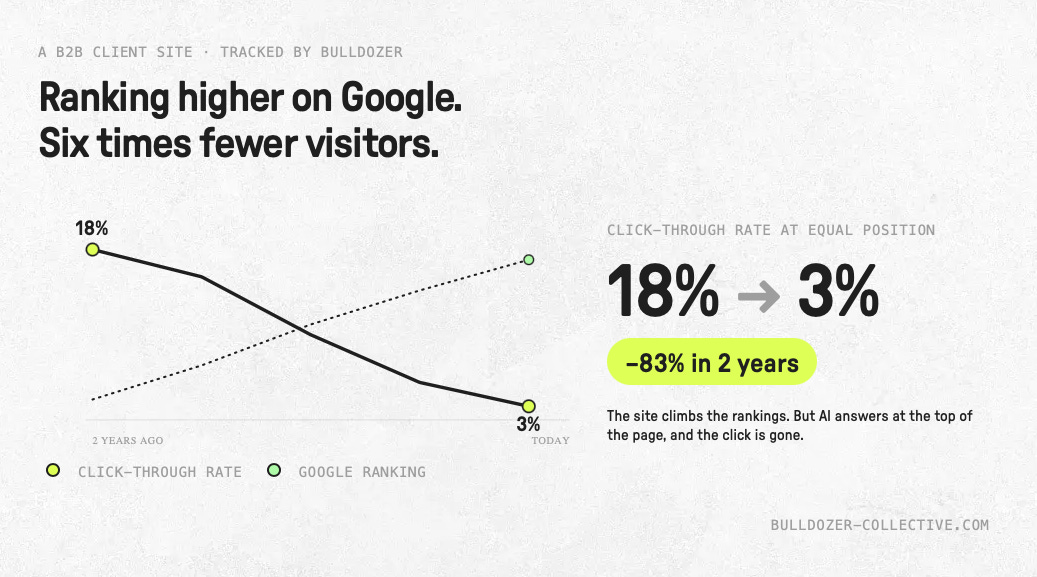
One number, from a Bulldozer client (a B2B software company).
In two years, their site climbed from page 2 to the top of page 1 on Google. On paper, a win.
Except at the same position, their click-through rate went from 18% to 3%. Let me repeat that: the same rank now brings six times fewer visitors than it did two years ago.
The site didn’t drop in Google’s rankings. The click disappeared, swallowed by the AI answers at the top of the page, and by ChatGPT.
The whole promise of 2010s SEO, collapsing.
Same fight on paid, where leads cost more and more. From our calls: a cost per lead that went from €20 to €58 on Meta, €74 on Google. A retail client whose qualified leads dropped fourfold (quoting the CMO: “the audience is exhausted”). A founder doing the math: his lead costs €30 organically, €150 in paid to replace it.
Multiply your budget by five to get back what free used to give you. That’s the real bill for depending on capture.
How to dig your own grave
The same movie plays out, in this order.
First, the bidding war. Everyone piles onto the same keywords, increasingly onto their own brand name. One client tripled to quadrupled their “brand” budget just to stay visible when someone types their name (and to keep showing nice paid CPLs). They pay to defend ground they owned for free a few months ago.
Then, the doubling down. When a channel stops delivering, the reflex is to widen the audience. One client took monthly spend from €3,000 to €6,500. The result: “the more we spend, the more we reach off-target people.” You pay more and more for prospects who care less and less.
Finally, the panic. This is the one that traps you. A marketing lead told us about her backstage: her CEO writing every day, “we put in more budget, why aren’t there more leads?” “Total panic, all hands on deck, we have to fill an air pocket.” Under pressure, you cut what pays slowly (content, brand) to fund what shows up immediately (paid). You dig the hole you’re trying to fill.
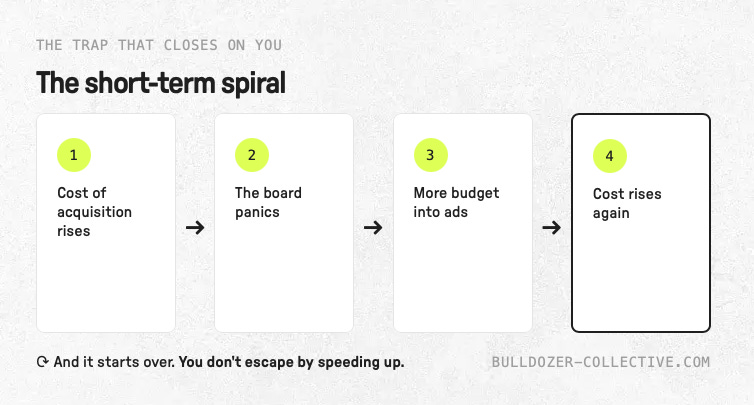
That’s the spiral: cost rises, the board panics, you pour more into the most expensive channel, cost rises again. You never get out the top.
The way out: go back to creating demand
Let me start with what “creating demand” means to me, because it gets interpreted every which way.
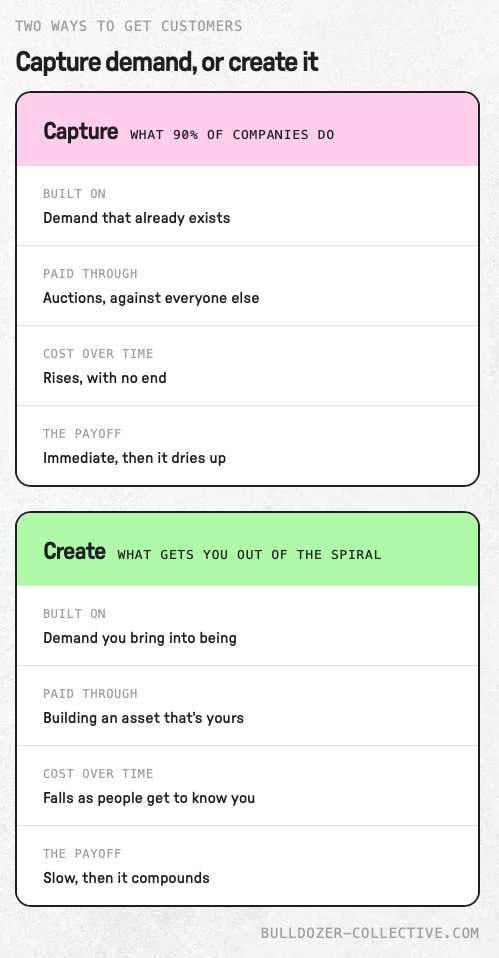
It’s making people want you before they go looking, so you stop depending only on those already searching. Concretely:
First, change what you watch. Track brand search instead: the number of people typing your name into Google, ChatGPT, wherever. That’s the real thermometer of the demand you create. As long as you only steer paid cost-per-lead, you’re steering capture, not creation.
Then, reallocate. Take a slice of the budget that just rebuys the same audiences and put it into content that says something about you, to people who don’t know you yet. Not generic content AI recopies and summarizes in two lines. A point of view, your own numbers, a stance you own.
What should guide the effort: being there before the search. Your buyers spend their days on LinkedIn, YouTube, podcasts, communities, long before they open Google. When HubSpot lost 15 to 40 million blog visits in a year, their answer wasn’t to pour more into search. They went and occupied those spaces.
(Worth a listen: my episodes with Kieran Flanagan, SVP Marketing at HubSpot, and Kipp Bodnar, its CMO, who walk through the decisions behind it.)
Put faces forward. The founder and the experts speaking in their own name build more attachment than any banner. It’s slow, it demands a point of view, and it’s one of the few channels that doesn’t get repriced at auction.
Hold the line. Demand creation pays in months, not days. That’s exactly why people abandon it at the first air pocket. And exactly why it stays an edge: almost nobody has the patience to keep it up.
Bid more, or create more
You have two options.
Keep paying ever more for an ever-smaller slice of people already searching.
Or go back to creating demand, so people come looking for you.
The first is comfortable. It gives you a number Monday morning. It’s also the one that locks you in the spiral.
A founder hesitated to start: “what if we’re not even good at capture yet?” My answer: in a lot of markets, there simply isn’t enough demand left to capture.
We get into the detail in a free webinar.
Let’s grow 👊
— Jordan