


“We want to automate part of our teams’ work with AI. We have no idea where to start.”
It’s the request we get most since January, and it almost always lands from the exec team with a yearly target attached and a deadline on it.
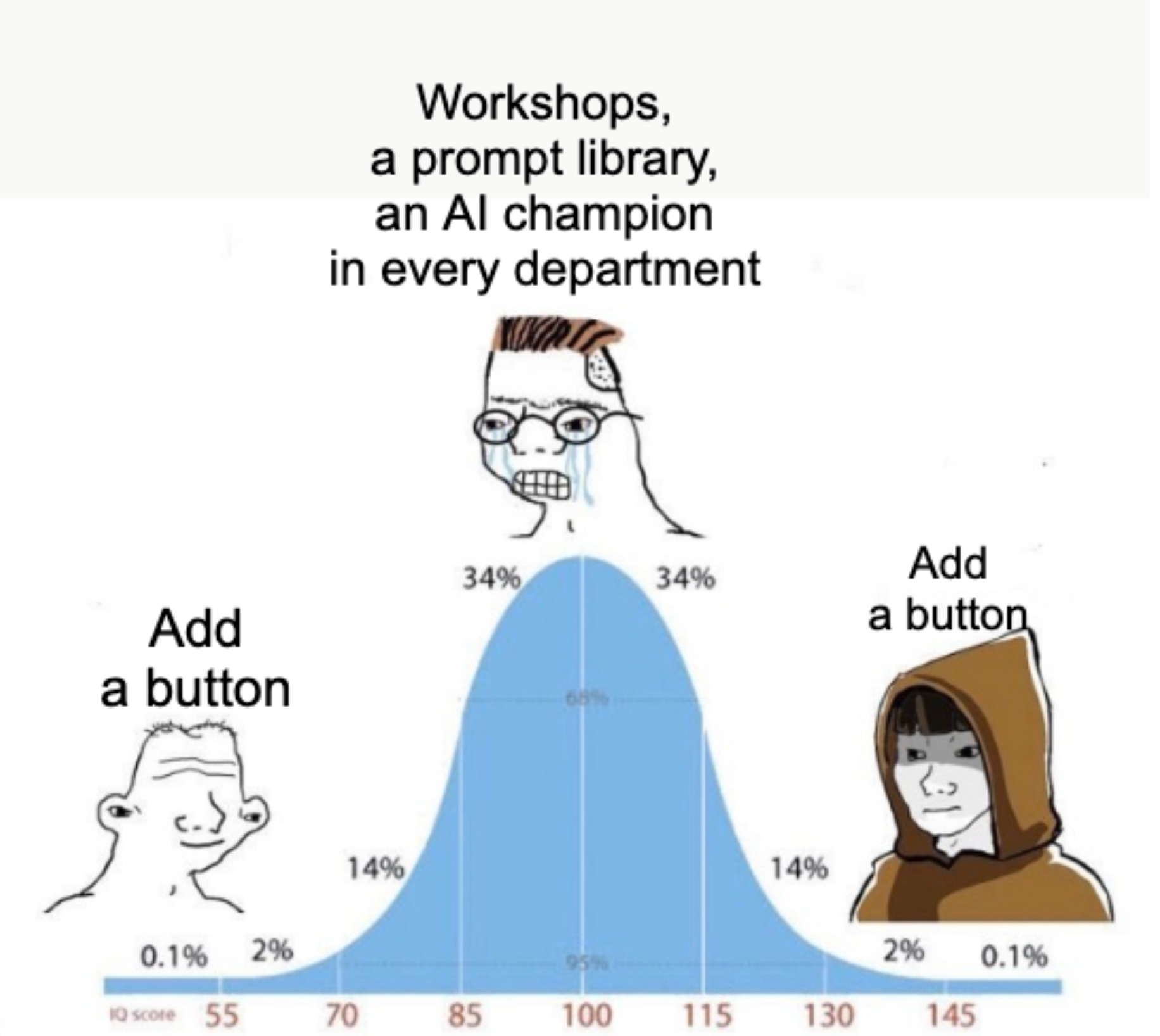
By the time it reaches us, the company has usually picked its own answer: a training plan.
Workshops, a prompt library, an AI champion in every department, the whole thing tied up with a bow. It’s an easy sell.
Spoiler: it lasts three weeks 😅
(The training plan does have one genuine merit: it looks fantastic on a board slide!)
The part everyone wants to skip
When we start one of these rollouts with Bulldozer, we don’t touch AI at all. We watch people work.
What they open, in what order, what gets copy-pasted between windows, and at what hour of the day.
Then we write it all down. Company context, brand, internal vocabulary, the market signals worth tracking, the processes… On our side that lives in Bulldozer OS, which exists for a fairly unglamorous reason: this layer takes weeks to assemble by hand and it’s the same work on every account.
By the end, the OS knows the company. What it sells, who it sells to, and which numbers matter.
The rocket is ready to fly to Mars but… usage stays at zero.
But why? Everything is right there!
The moment we got it
The first time this happened we went digging into change management. Long story short, that’s a real part of it and it does matter. But you always land back on the same question: how?
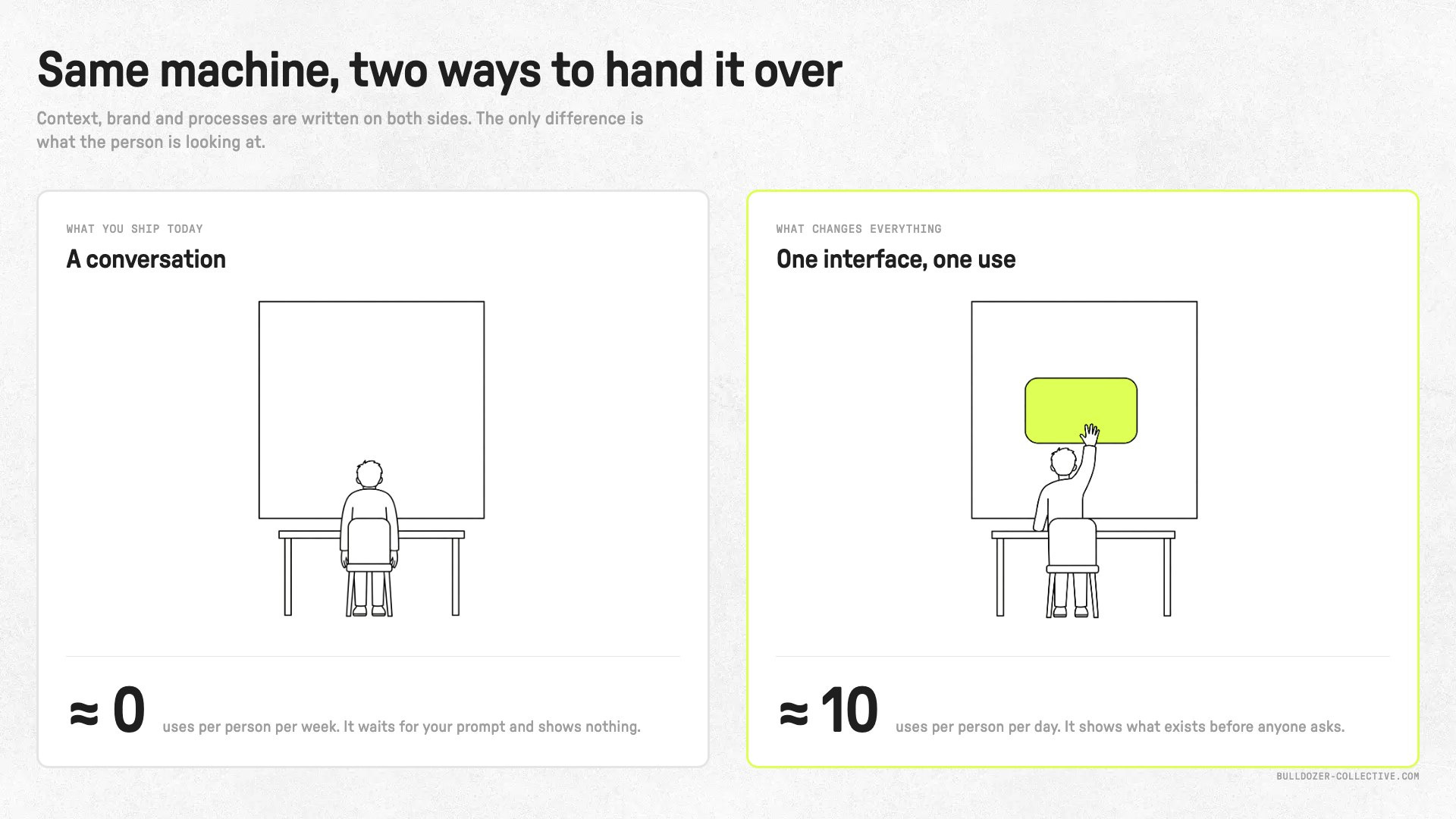
Because what’s actually happening is simple. You built a machine, it works, and you’re asking your team to fly it through a conversation. Except a conversation shows you nothing! It sits there waiting for your prompt.
Put yourself in the seat of the person who opens Claude or ChatGPT on a Tuesday morning. They know something big sits behind it (a whole machine that flies to Mars), but they don’t know what to type, what to ask, and above all where the edges are!
Meanwhile fourteen emails and notifications are waiting. Right… Mars can wait!
The end.
The clearest example, to me, is data. Ask Claude where we stand on a number and the answer lands in ten seconds, sourced. Our clients still want a dashboard with the numbers already on screen.
Some call that resistance to change. I think it’s mostly that a dashboard shows what exists without anyone having to ask for it!
Four steps that actually move the number
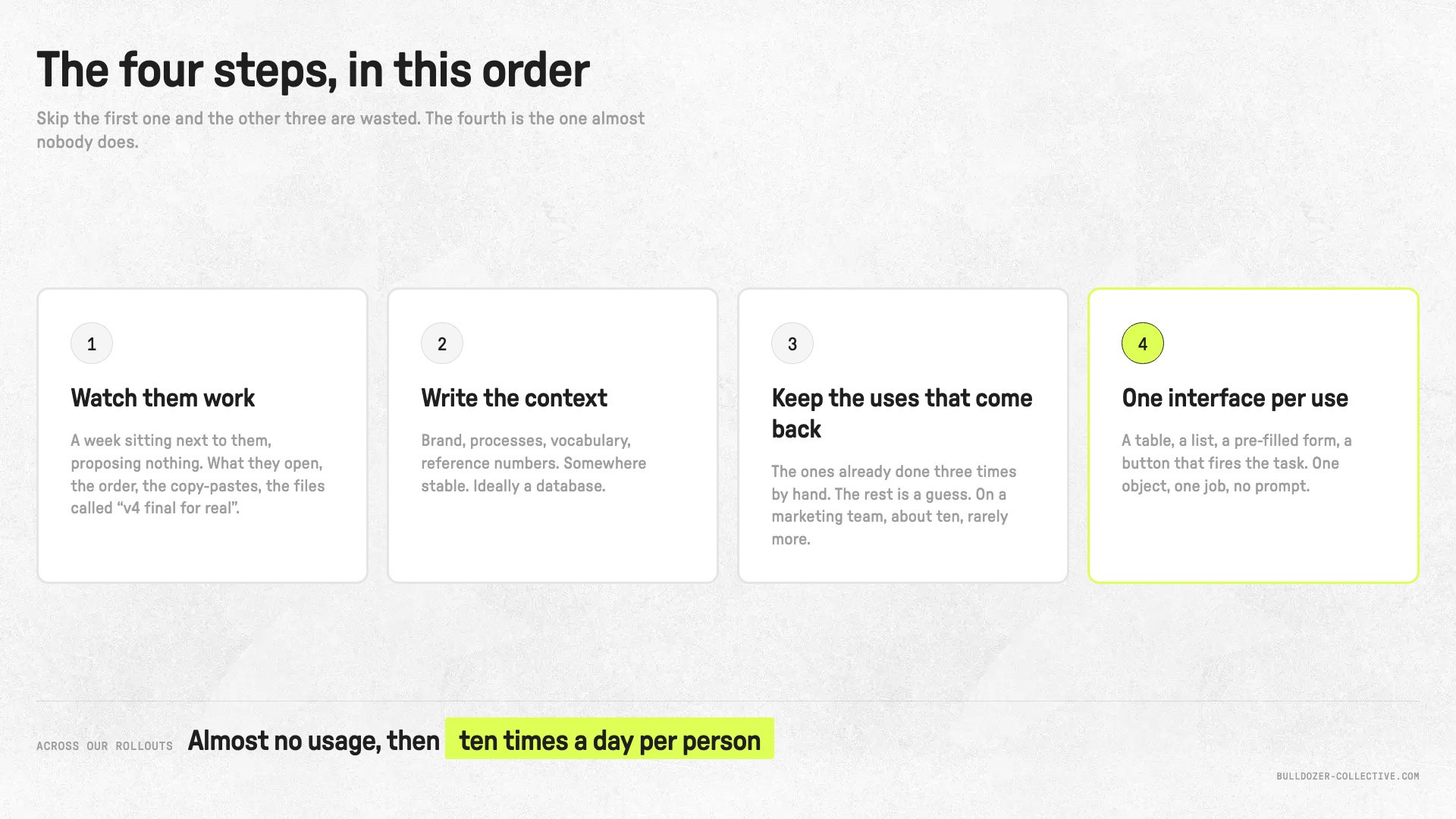
1. Watch them work for a week, without proposing anything.
Sit next to them. Write down what they open, the order they chain it in, what moves between two windows, and the files called “v4 final for real” (we’ve all got one). That’s where the repeat uses live, and nowhere else. No survey will get them out, because nobody volunteers the thing they do on autopilot.
2. Write the context before building anything.
Brand, processes, vocabulary, reference numbers. Somewhere stable. Ideally a database.
3. Keep only the uses already done three times by hand.
A use that keeps coming back is a use that exists. The rest is a guess, and guesses get expensive in tokens. On a marketing team you’ll find ≈10, rarely more.
4. Build one interface per use 🚨
This is THE hack. A table, a list, a pre-filled form, a small app with a button that fires the task or the whole process. One object, ONE job, and nobody has to explain it. No prompt, just a button (say: “Create my SEO brief”).
That’s the step where the number moves. Across our rollouts we go from almost no usage to roughly ten times a day per person. Same model, same team, same written context. The only thing that changed is what they’re looking at.
Four rules so you don’t repeat our mistakes
Build nothing for your technical people. Your two or three power users are fine in the chat, because they already know what’s in there.
Start with the things people can see. For everyone outside the technical crowd, a table beats a good answer. We haven’t hit an exception yet.
Put an expiry date on everything you build. These things are meant to be thrown away. Needs shift, models get better, and rebuilding is cheap now (which is one of the real wins here!).
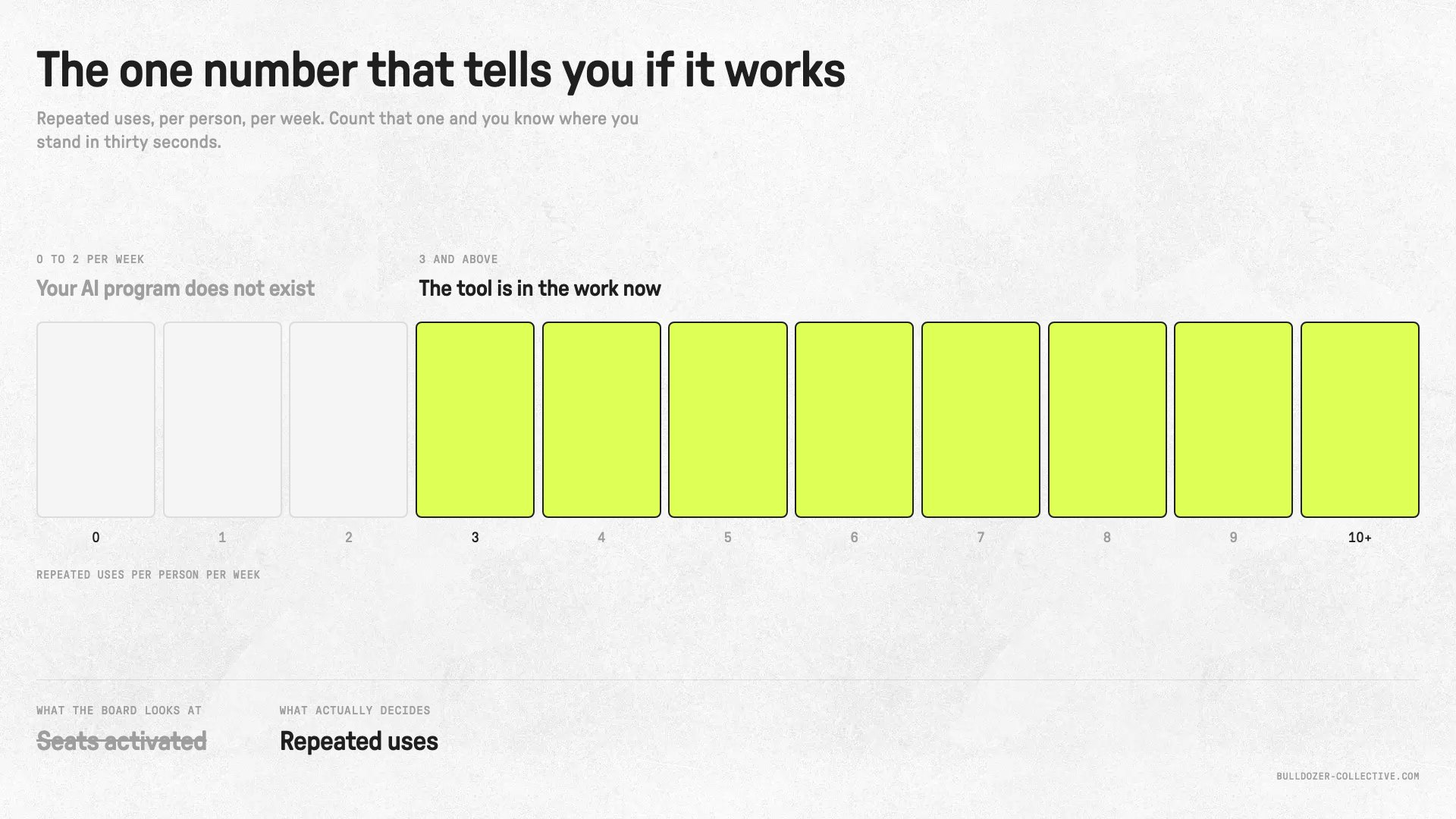
Your metric is repeated usage, per person, per week. Full stop.
Your call
You can fund one more training session. Or you can take the three things your team already redoes by hand every week and put a screen in front of each one before the month is out.
And yes, as you’ve probably worked out, this is something we do.
Let’s grow 👊
Jordan