


In 1948, the U.S. Supreme Court ruled against Paramount Pictures in a landmark antitrust case. The decision forced Hollywood studios to sell their theater chains.
For decades, studios had operated like factories. They owned everything: soundstages, equipment, distribution channels. They employed everyone full-time: actors, directors, writers, editors, costume designers. Louis B. Mayer at MGM had 4,000 employees on payroll.
Then, almost overnight, everything changed.
Studios started assembling talent project by project. Directors became free agents. Specialized crews formed and dissolved around specific films. The “gig economy” was born—70 years before Uber!
The result? The 1970s gave us The Godfather, Jaws, Star Wars. The most creative decade in cinema history came from dismantling the factory model.
Why does this matter to you?
Because most marketing organizations still operate like 1940s movie studios.
I’m not saying you are stuck in the past. Many companies already mix in-house talent with agencies and freelancers. The question isn’t “should I outsource?”—most of you already do—but how do I decide what stays in-house, what goes external, and now, what can AI handle?
The new paradigm
AI compresses timelines. What took a content team 2 week now takes a few days. You don’t need the same headcount to produce at the same volume.
Channels break faster. SEO, as we knew it, is getting disrupted. Paid costs keep rising. The tactics you hired specialists for in 2024 might be obsolete by 2026. Betting your org structure on specific channels is risky.
Specialists get better outside companies. A paid media expert working with 15 clients sees 15x the tests, 15x the learnings, 15x the pattern recognition. Your in-house hire sees... one company.
A decision framework I like
Peter Mahoney (CMO at GoTo, 300+ person marketing team) uses a simple model:
Full-time → Critical to your strategy + long-term need + affordable
Part-time → Specialized skills + episodic need + short-term
Outsource → Not core differentiation + hard to source + need to scale up/down
Simple. But now there’s a fourth question: Can AI do this?
Here’s how I’d update the framework:
Before hiring anyone (internal or external), ask:
Is this core to our differentiation? If yes → keep it close (in-house or trusted long-term partner)
Does this require deep company context? If yes → in-house
Does this require specialized expertise that compounds across clients? If yes → outsource to specialists
Is this repetitive execution that follows clear rules? If yes → AI + human oversight
Do I need to scale up/down with demand? If yes → external or AI
Let me give you concrete examples:
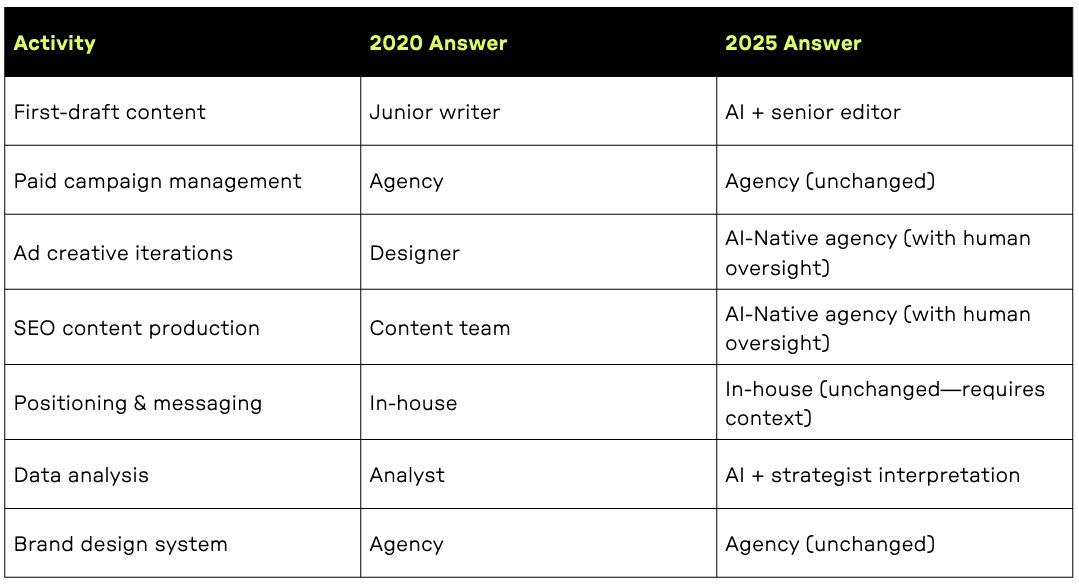
What we’ve learned at Bulldozer
I’ll be honest: when Enguerrand and I started Bulldozer, we chose the “collective” model for practical reasons. It was a side business. We didn’t want employees. We didn’t want the fixed costs.
Five years later, we’ve grown significantly. We’ve hired full-time people where it makes sense (strategy, client relationships, operations). But the collective model for execution? We never challenged it.
Because it works.
You get A/B-players on every project. Not the interns that get assigned after the sales pitch (every CMO knows this agency trick).
You test channels with external specialists first. If two different contractors fail on the same channel, the problem is internal—your brief, your positioning, your content. Not the tactic. This saves you from bad full-time hires.
You scale up and down with demand. Q4 push? Add capacity. Slow Q1? Reduce. No layoffs. No hiring freezes. No carrying costs for skills you don’t need year-round.
You access expertise that compounds. A freelance paid media expert working with 30 B2B SaaS companies has seen what works. Your in-house hire is learning on your budget alone.
The 3 conditions for outsourcing to work
Fair warning: this model fails without foundations. I’ve seen it become a nightmare when these aren’t in place:
Clear company vision the external team can align to.
Defined ICP and market hypotheses. Even if rough.
Measurable objectives with a simple way to track them.
Without these, you’ll spend your time doing quality control instead of strategy. You’ll have endless back-and-forth. You’ll blame the contractors when the real problem is internal chaos.
If you’re building or rebuilding your marketing org
Keep in-house:
Strategy and positioning (requires deep company context)
Brand voice and editorial direction (the “editor” role)
Customer understanding and research
Outsource or use part-time help:
Paid acquisition management
SEO execution (technical and content)
Design production (after brand system is set)
Content writing (with strong briefs and editing)
Video production
PR and media relations
Test before hiring: When exploring a new channel, use contractors first. If it works, you can internalize. If it fails twice with two different partners, the channel probably isn’t right for you—and you avoided a bad hire.
The AI layer
One more thing: AI changes the “should I hire?” calculation.
Many tasks that required a specialist 2 years ago can now be done by a generalist with good AI tools. First-draft content. Basic design iterations. Data analysis. Campaign setup.
This means:
Hire fewer people overall
Hire people who can use AI well (this is now a core skill, not a bonus)
Invest in specialists only where human judgment and relationships matter most
The in-house marketing team of 2026 looks more like a film production company than a factory. A small core crew (director, producer, editor) surrounded by a network of specialized talent assembled for each “project.”
Hollywood figured this out 70 years ago. Your marketing org just needs to catch up.
Let’s grow 👊
--- Jordan