


This chart has been making the rounds lately. It maps what LLMs can theoretically do across job categories (blue) versus what they actually do today (red).
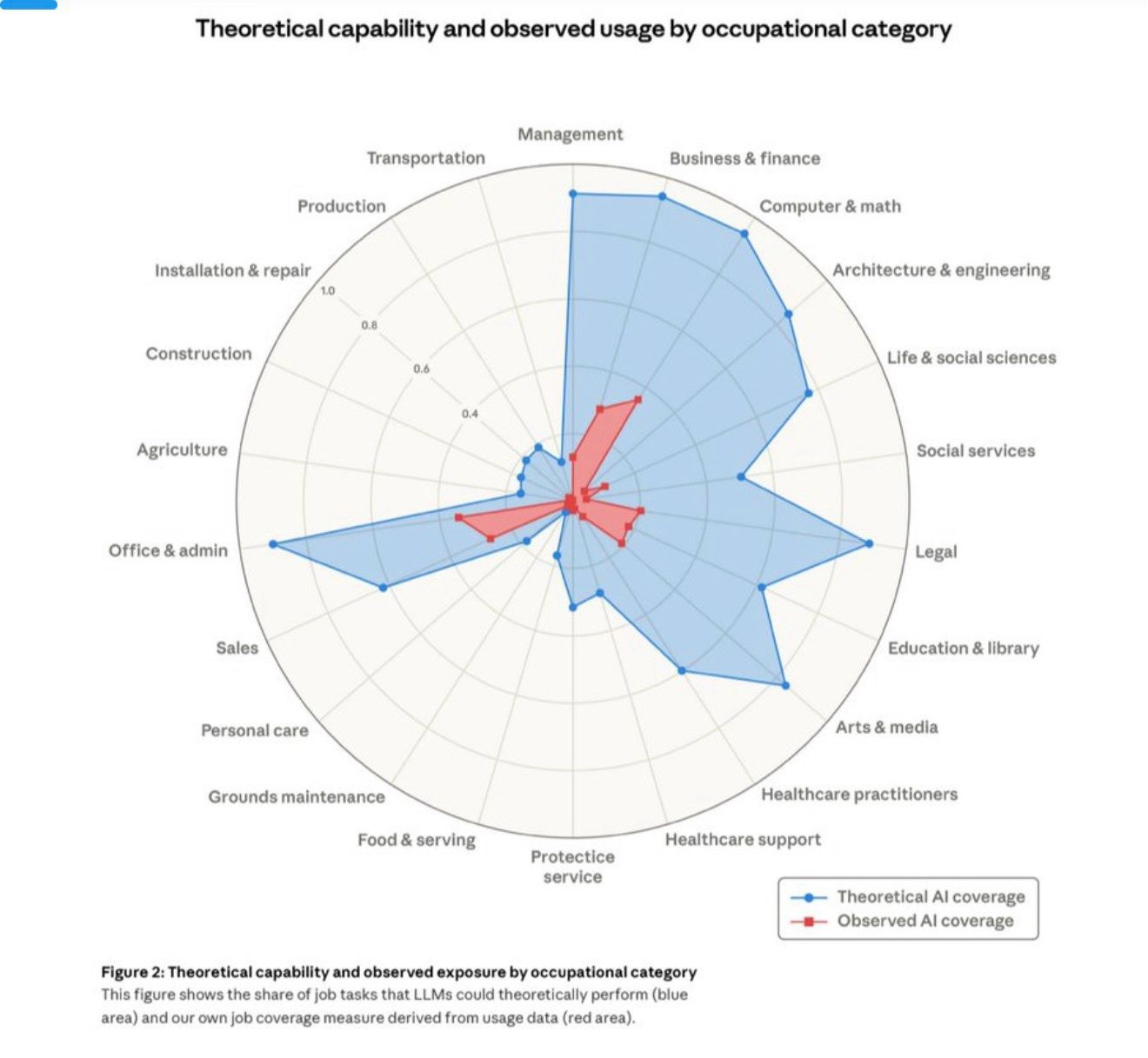
Most of the conversation around it focuses on which jobs AI will replace. But looking at it as a marketer, I had a different question: which channels are structurally out of reach for AI saturation — at least for now? Where is the uncrowded space?
That’s what this edition is about.
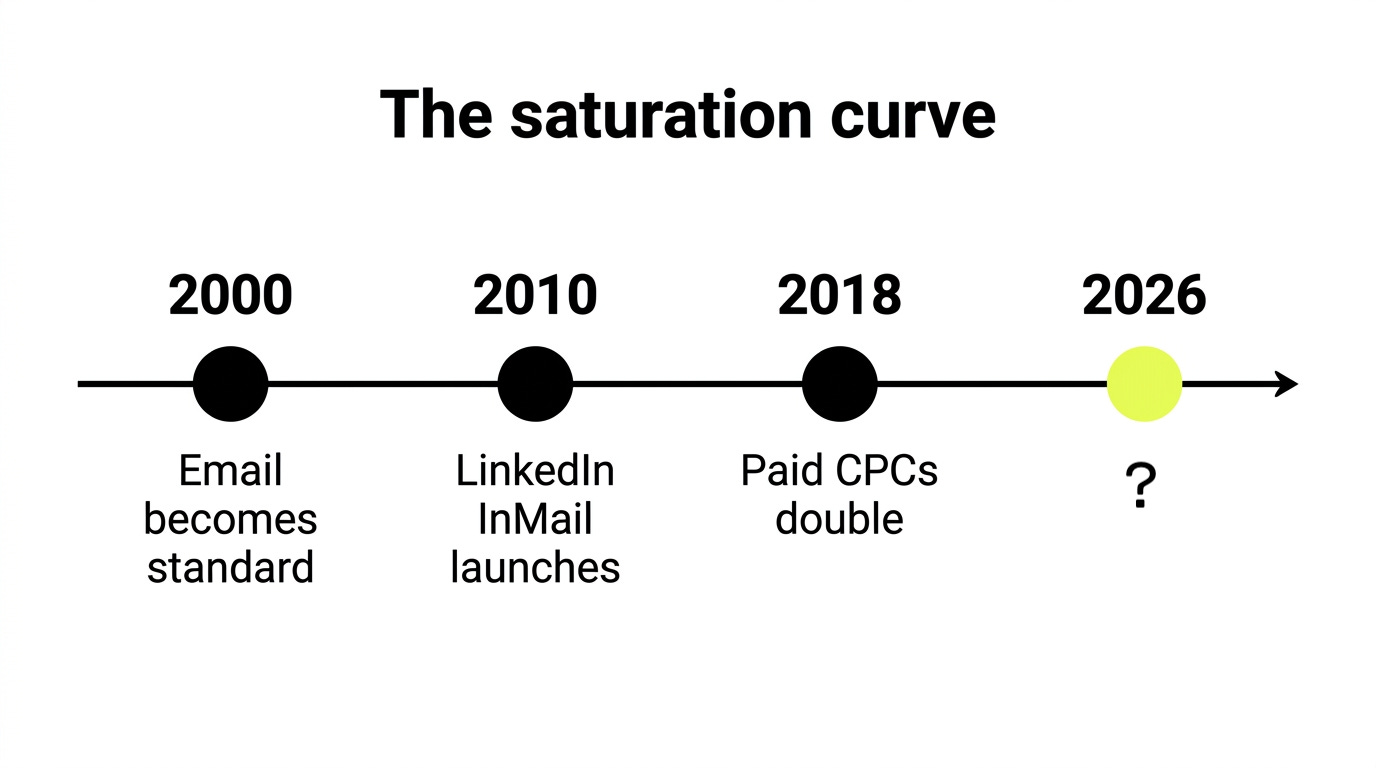
In 1983, American Express mailed 25 million letters in a single year. Handwritten salutations. Individual names. Personalized offers. Response rates: consistently above 3%.
Forty years later, that same 3% feels almost mythological. Today’s average B2B cold email gets a 2% open rate on a good day, and a 0.1% reply rate if you’re lucky. LinkedIn InMail? 15-18% open rate when it worked. Now closer to 8%.
B2B CPL across paid channels has inflated 40-70% since 2021 depending on your vertical. LinkedIn CPCs are up 30%+ year-over-year. Google Ads CPCs for competitive SaaS terms regularly clear €20 per click. Email deliverability is under permanent pressure — domain reputation, inbox placement, GDPR friction.
Your 2026 marketing plan probably has more LinkedIn budget, more email sequences, more retargeting layers. So does your competitor’s.
You’re fighting over the same 3-5% of buyers who are actively in-market right now. The other 95%? You’re not reaching them. Or more precisely: you’re reaching them on channels so saturated they don’t see you.
So let’s talk about five channels. All underused. All working.
Direct mail
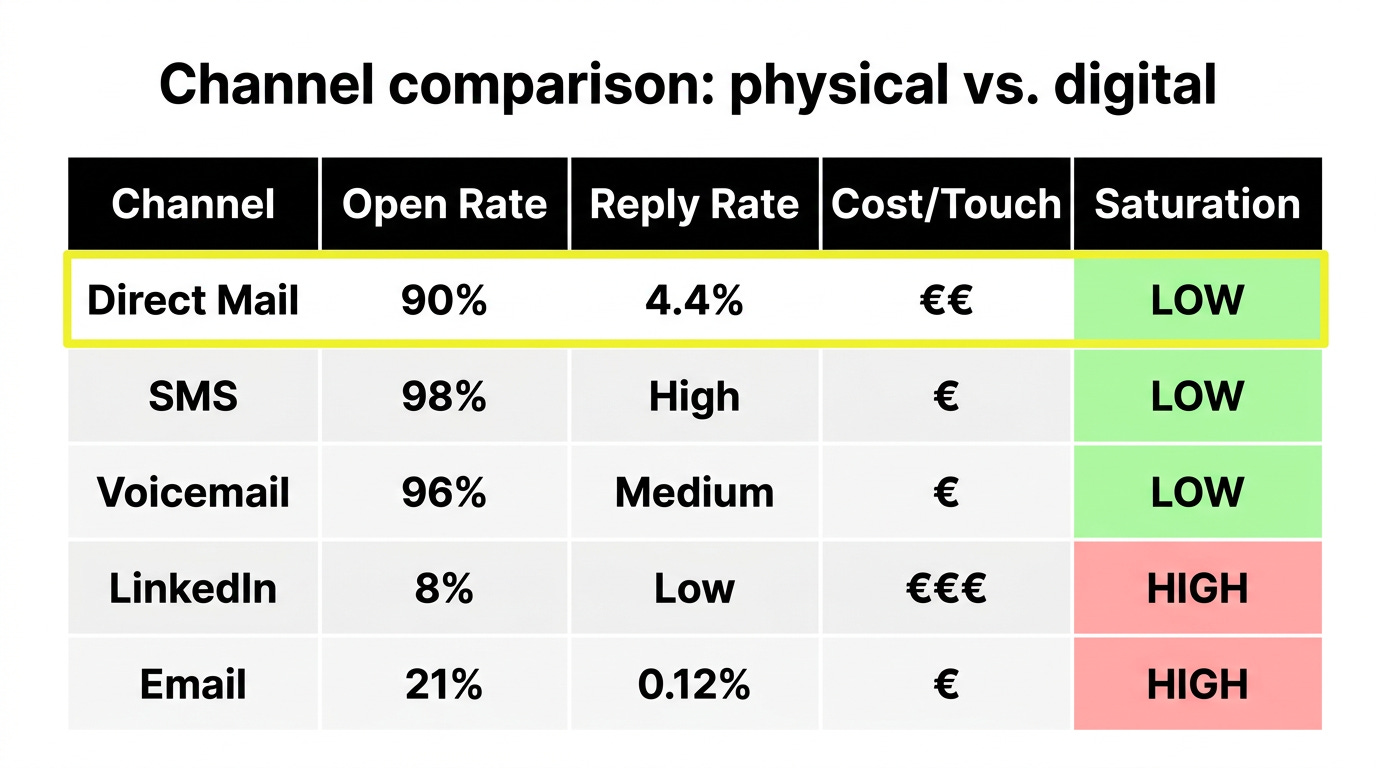
The DMA’s most recent B2B benchmarks put direct mail response rates at 4.4%. Email averages 0.12%. Direct mail is 36x more likely to get a response.
Physical mail gets opened. When a CMO at a €50M ARR SaaS company receives a physical envelope with their name (not “Marketing Leader at [Company]”!) it gets opened!
There’s no spam filter. No Promotions tab. No unsubscribe button.
At Bulldozer, we’ve run direct mail sequences for three enterprise B2B clients (deals above €50K ACV) over the last year. Same pattern across all three: accounts cold for 60+ days on every digital channel responded within a week of a physical touchpoint. A pattern break in a sea of identical digital touches.
───
📍 The right list: accounts in your CRM for 90+ days with 6+ digital touches and zero response. They’ve seen your emails. The letter is the interrupt.
📍 What to send: one page, signed by your CEO, SDR or AE. Nothing promotional in the first touchpoint. Open a conversation, not a pitch.
📍 One caveat worth naming: direct mail is a precision play, not a volume play. The economics hold at 50-100 accounts. At 5,000, you’re back in the same crowded game.
Gifting and dimensional mail
One step further on the physical spectrum. A book relevant to your prospect’s current challenge. A curated package tied to something specific about their business. Platforms like Sendoso, JeudiMerci (FR), Gyfti (FR) and Reachdesk handle fulfillment and CRM tracking.
Most B2B marketers haven’t touched them. The reason: it feels like too much effort. That’s exactly why it converts. An account that receives a €40 relevant gift from your company doesn’t forget it.
───
📍 Right trigger: a deal gone cold after 4+ weeks of digital touches. The message should reference something specific about their situation — their Q3 results, a recent initiative, a competitor move. Specificity is what makes it land.
Handwritten cards
Genuinely rare in B2B. A VP Sales who sends 10 handwritten notes per week (nothing promotional) generates replies that email sequences don’t. Volume ceiling: 40-50 per month at quality. Scale with Handwrytten or Manuscry (FR) to hold quality at 100+ per month.
Executive dinners and private events
A dinner for 12 CMOs. A private roundtable working through a problem they’re actively navigating. An in-person workshop with real content (not a sales pitch repackaged as education…).
Physical presence with a curated audience is where pipeline builds quietly.
───
📍The math: 12 people in a room, 3 become clients at €80K ACV = €240K pipeline from a €5K dinner. Webinars went digital and crowded. This format hasn’t.
Voicemail drops (and what AI changes)
Ringless voicemail (RVM) delivers a pre-recorded message directly into someone’s voicemail without the phone ringing. No disruption. No cold call awkwardness.
Industry average open rate: 96% 😅
The use case: 20-50 key accounts where you want a decision-maker to hear a human voice. Under 30 seconds. Something like: “I wanted to reach you personally. We’ve been working with three companies in your space and I’ve seen something specific to your situation. Worth 15 minutes?”
At €0.05-0.10 per send, the cost per touchpoint is a fraction of SDR time spent on cold calls that go to voicemail anyway.
Now add voice cloning. ElevenLabs or Bland.ai can clone your CEO’s voice from a 3-minute audio sample. You record once. Your team delivers 500 personalized voicemails with your CEO’s actual voice — each opening with the prospect’s name and one company-specific observation. The CEO’s 20 minutes per week of outbound voice becomes 500 touches without losing the human signal.
The companies running this today are ≈12 months ahead of when it becomes standard practice.
───
📍Legal note: in most EU markets, RVM sits in ambiguous territory under ePrivacy. In France, outbound calls to B2B numbers are generally permitted under legitimate interest. Validate with legal before running at volume. In North America, standard practice.
SMS: build the list now, use it later
98% open rate. Average read time: under 3 minutes.
Email’s best case: 21% open rate, read 6+ hours later.
At Bulldozer: SMS reminder sent 2 hours before a webinar vs email-only control group. Show-up rate increased 28%. Same content, different channel.
SMS has a hard prerequisite in Europe: explicit opt-in. Every conversion touchpoint — demo confirmation, event registration, content download — is an opportunity to collect it. 500 clean permission-based contacts delivers more than 10,000 cold addresses.
───
📍 Use it for: event reminders, deal-stage nudges, re-engagement after email silence.
Five moves to start this month
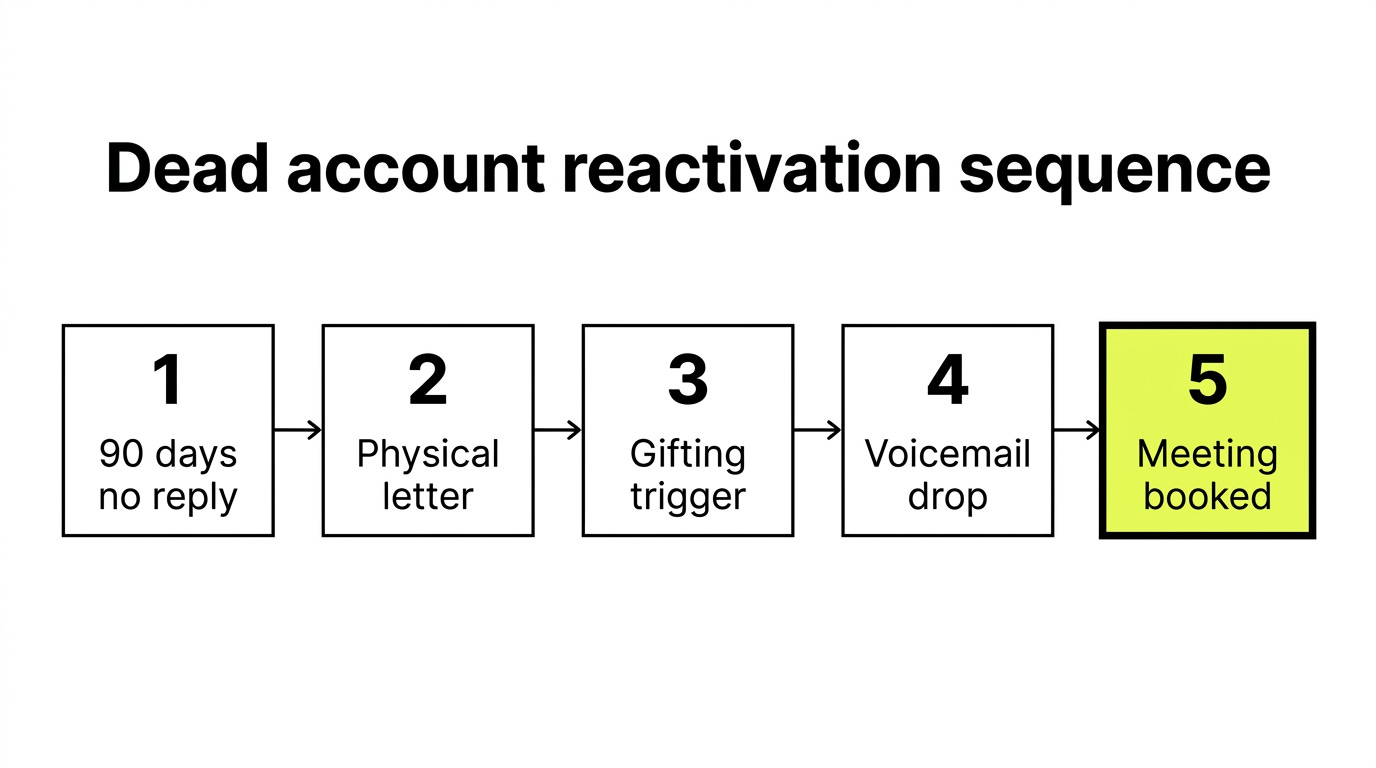
1. Digital dead-end audit.
Pull your CRM. Find accounts touched 6+ times in the last 90 days with zero engagement. Top 50 by ICP fit. Top 10 get dimensional mail — a relevant book or curated package. The other 40 get a one-page letter from your CEO with one observation specific to their business.
2. Set up a gifting trigger.
Pick the deal stage where you lose the most accounts. Configure: deal goes 4 weeks without activity → €30-50 relevant gift with a handwritten note. Measure meetings rebooked within 30 days against your current no-action baseline.
3. Voice clone test on 20 accounts.
Record your CEO for 3 minutes. Clone the voice with ElevenLabs (free tier gets you started). VP Sales writes 3 scripts — one per core ICP persona. Drop on accounts dark for 45+ days. Measure any re-engagement signal at J+7: email reply, LinkedIn connection, SDR callback.
4. One handwritten note per day.
Your VP Sales, one note per business day to a target account. One observation, nothing promotional. Run it for 6 weeks and track reply rate.
5. Build one SMS opt-in touchpoint.
Add optional SMS opt-in at your highest-intent conversion moment with a clear value statement. Start building the list now. You’ll use it every quarter.
One thing you can’t skip: compliance 🫠
Physical mail to B2B company addresses: permitted under legitimate interest in most EU markets. Validate on your specific scenario.
Gifting: no regulatory issue generally, but enterprise companies have internal policies. Check before sending anything over €50.
Voice cloning + voicemail: same rules as outbound calls in your market. Get legal to sign off before running at volume.
SMS: explicit opt-in required in Europe. No exceptions.
The best growth channel isn't the newest one. It's the uncrowded one.
These channels work because they require effort and judgment. Handwritten notes don’t automate. A curated executive dinner doesn’t scale to 10,000. That friction is the feature. The same automation flooding email and LinkedIn hasn’t reached these formats. When it does, something else will open up.
Let’s grow 👊
— Jordan