


In 1839, when photography arrived, painters panicked.
Why commission a portrait when a camera captures a face in seconds? What actually happened was the opposite. Fine art markets exploded. The handmade became precious. Mechanical reproduction made crafted work more valuable, not less.
The same dynamic is playing out right now in B2B marketing.
Everyone has the same tools now
When I look across the marketing teams we work with at Bulldozer, there’s a clear pattern: everyone has access to the same AI stack. Claude, ChatGPT, Midjourney…. Same models. Same prompts. Same outputs. Same posts. Same decks.
71% of consumers distrust brands that rely heavily on AI-generated communication (Edelman, 2024). And it’s not because they are anti-AI. It’s because they are pro-craft! They’re rejecting generic. And when your tools are the same as your competitors’ tools, the only differentiator left is what you bring to the prompt.
You and your competitors can spin up a blog post in 45 seconds. You can produce 200 social assets a week. Speed is no longer a differentiator.
What differentiates is how you use those tools. And how you use them is determined by one thing: the quality of the system you built around them.
Craft ≠ artisanal = system.
Let me be precise about what I mean, because this gets misread.
Craft is not about slowing down or going analog. It’s about having a documented, transferable, teachable system for what ‘good’ looks like for your brand specifically.
Your visual identity: not just a logo and a hex code. The specific weight of your font, the exact spacing on your layouts, the way your brand uses negative space, the image style that feels like you and not like a stock library.
Your motion language: how your UI animations feel, whether transitions are snappy or breathe, what energy your brand communicates when things move.
Your tone of voice: the words you never use, the rhythm of your sentences, the level of formality with your audience, the topics you own versus the ones you leave to others.
None of this comes preloaded in ChatGPT.
When you give a well-configured AI agent a detailed brand playbook — colors, voice, examples, explicit do’s and don’ts — the output is sharper, faster, and distinctly yours. When you give the same AI nothing, you get something that looks like everyone else.
When a client comes to us with a documented brand system, we can deploy AI across content, ads, and email sequences and stay on-brand at 10x the volume. A client without one generates volume and loses identity simultaneously.
The bottleneck is (and has always been) judgment.
Three things your brand system must codify
Visual architecture: not just a logo and a hex code. Your full design system — grid, spacing, hierarchy, image style, layout logic. The more specific, the more useful.
Voice guidelines: not ‘conversational and expert.’ Specific. What words do you use? What analogies work? What topics do you avoid? Provide examples, not adjectives.
Agent configuration files: every AI tool you use — whether it’s an LLM for copy, an image model, or an AI analyst — needs a brief. Written. Explicit. Documented. Think of these markdown files as onboarding documents for a creative partner who has never met your brand.
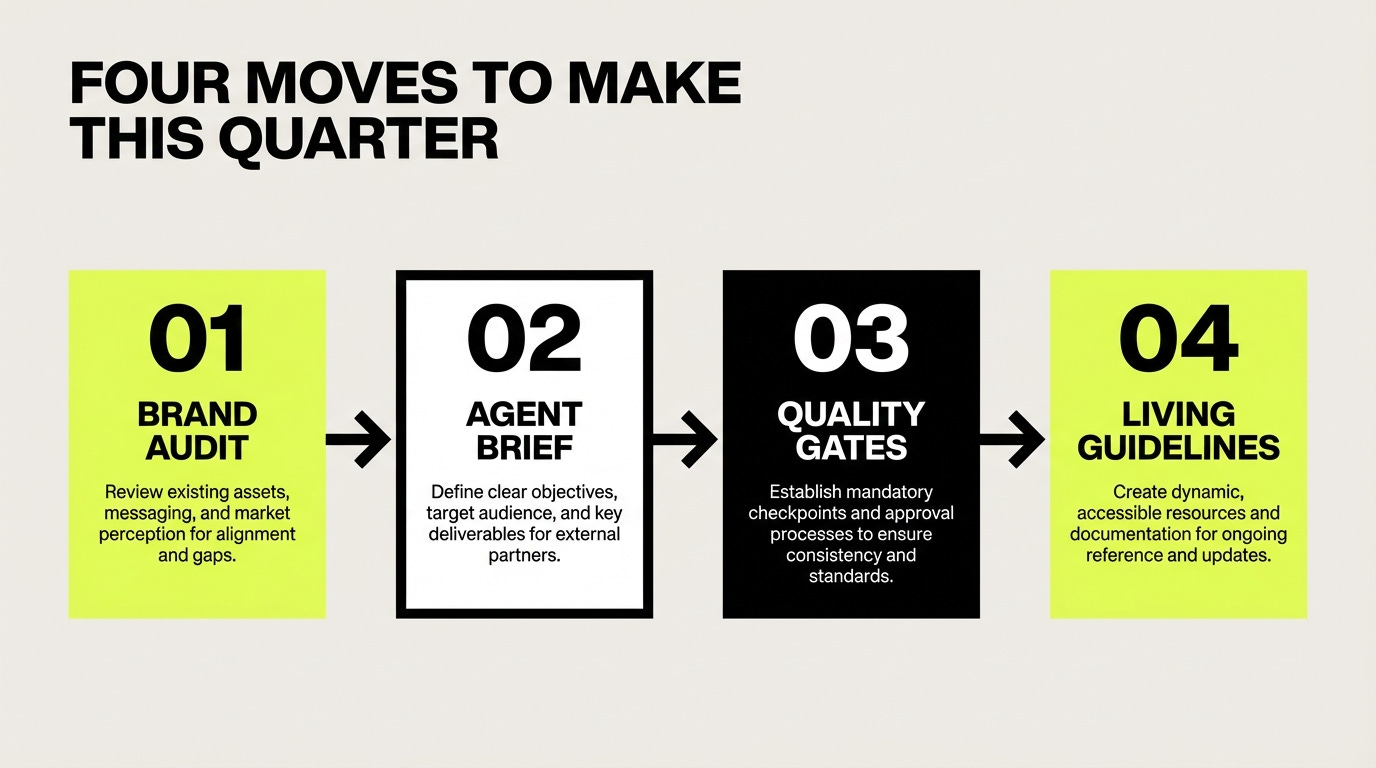
Four moves to make next month
Run a brand audit first. Before evaluating new tools, document what you have. Try to have your brand system on 3 pages max.
Build your agent brief. A markdown file covering: who you are, who your audience is, what you sell, your tone, examples of good and bad content, words you never say. This is the operating document your team’s entire AI workflow will run on.
Set quality gates. AI speed is only valuable if there’s a review step for brand fidelity. Build that gate into your workflow.
Treat guidelines as a living product. Update them quarterly. Add new examples, remove outdated ones. Your guidelines are the operating system. Don’t let them go stale.
When everything can be generated, the only thing that matters is whether people recognize it as yours.
What you want is to produce dinstinctive content — at speed.
Taste was never going anywhere.
It just got more expensive to ignore.
Let’s grow 👊
— Jordan