


Let’s start with the good news. Two Gartner surveys put marketing in the top three functions most likely to see their budget grow in 2027. Behind sales, behind IT, but ahead of HR, legal and finance, which are the three most heavily cut.
For a sense of scale, HR budget growth is set to fall from 2.4% in 2026 to 0.7% in 2027 🌀
That stings.
So the cut you are bracing for in your 2027 planning is not coming. Your CFO is not sharpening a knife with your name on it.
BUT (obviously), you are still going to get squeezed.
The Gartner survey, run with 401 CMOs between January and March, shows that inside that budget, 15.3% is now going to AI.
Tech. Paid for by marketing.
See the sleight of hand?
We are seeing the same thing land in our own inbound. Since 1 May 2026, across more than 200 sales conversations, 26.3% of inbound requests at Bulldozer are about deploying AI inside the marketing organization. These are internal transformation projects, paid for with marketing money.
(The data starts in May because before that, nobody was asking us for this.)
Who pays for the 15.3%
A Gartner study (again) published in June 2026 asks the blunt question: where did the money for your marketing AI program come from?
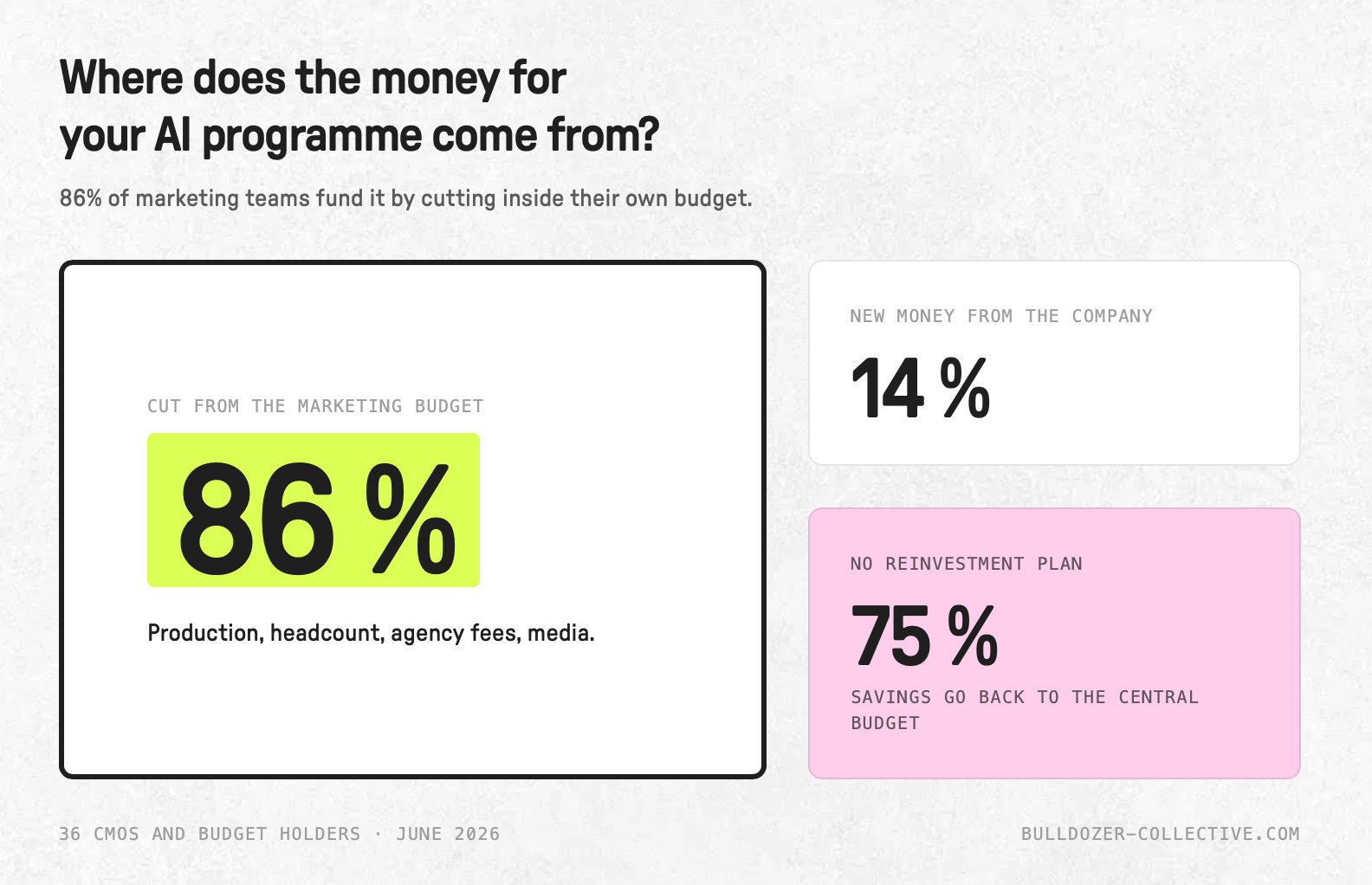
The answer: 86% funded it by cutting inside their own budget. Production, headcount, agency fees, media. Only 14% got new money from the company.
75% have no reinvestment plan. When the savings show up, they go back to the central budget.
Marketing pays for the experiment. The company keeps the ROI.
The obvious objection is that all of this is rational. If AI genuinely makes marketing cheaper, funding it from the marketing budget and handing back the savings is exactly what a well-run company should do. In The CMO Survey, CMOs report a 14.6% reduction in their own overhead thanks to AI, up from 7.2% in late 2023. On those numbers, finance is right and this newsletter is wrong.
Except somebody measured the actual return on those programs: between 0 and 10% on average 🥲
Only 7% have fully autonomous agents running in production. And 44% are funding the next AI wave with the savings from the last one.
So you are trading a known line for a return that lands at half its promise, and that you do not even get to keep 🥲🥲
Meanwhile belts are tightening, and it is starting to show.
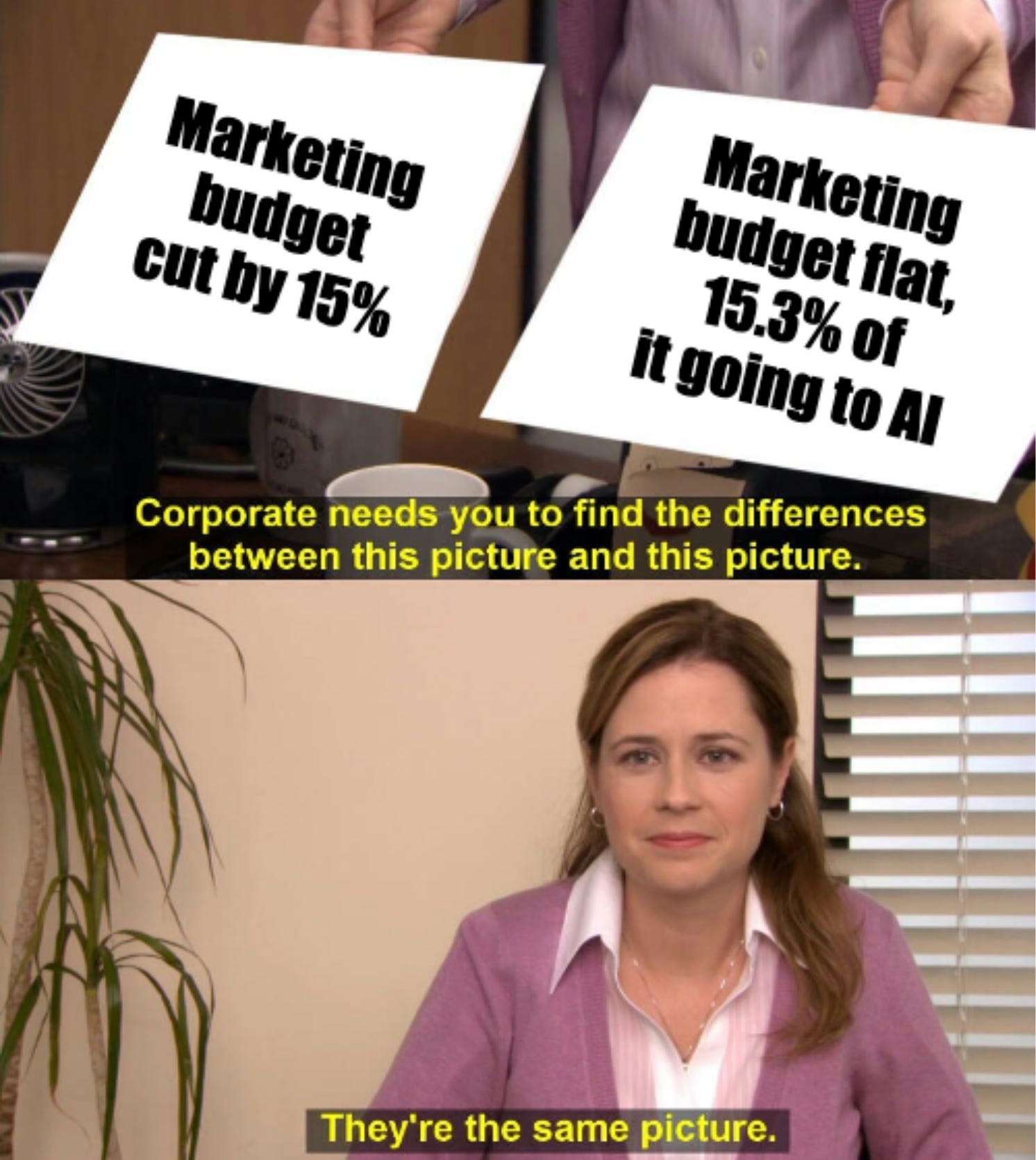
Flat budget. Rising revenue. A sixth of the envelope reallocated. Technically that is not a cut, which is exactly why it clears without a fight.
Measuring better, deciding less
Marketing measurement has never been this good, thanks to AI. Unfortunately, it has never bought so little.
1️⃣ Measurement made a spectacular jump.
Marketing teams using AI to measure performance and produce reporting went from 24.8% in late 2023 to 46.3% in early 2026. Google open-sourced Meridian in January 2025. Meta open-sourced Robyn before that. Just over half of US teams now run incrementality tests. The tooling problem that has occupied the last ten (twenty?!) years is largely solved.
2️⃣ It bought you almost nothing.
In July 2026, the World Federation of Advertisers surveyed 71 CMOs responsible for around $40 billion in annual ad spend. 80% already run marketing mix models and brand lift studies. 15% say that evidence actually determines how their budget gets set.
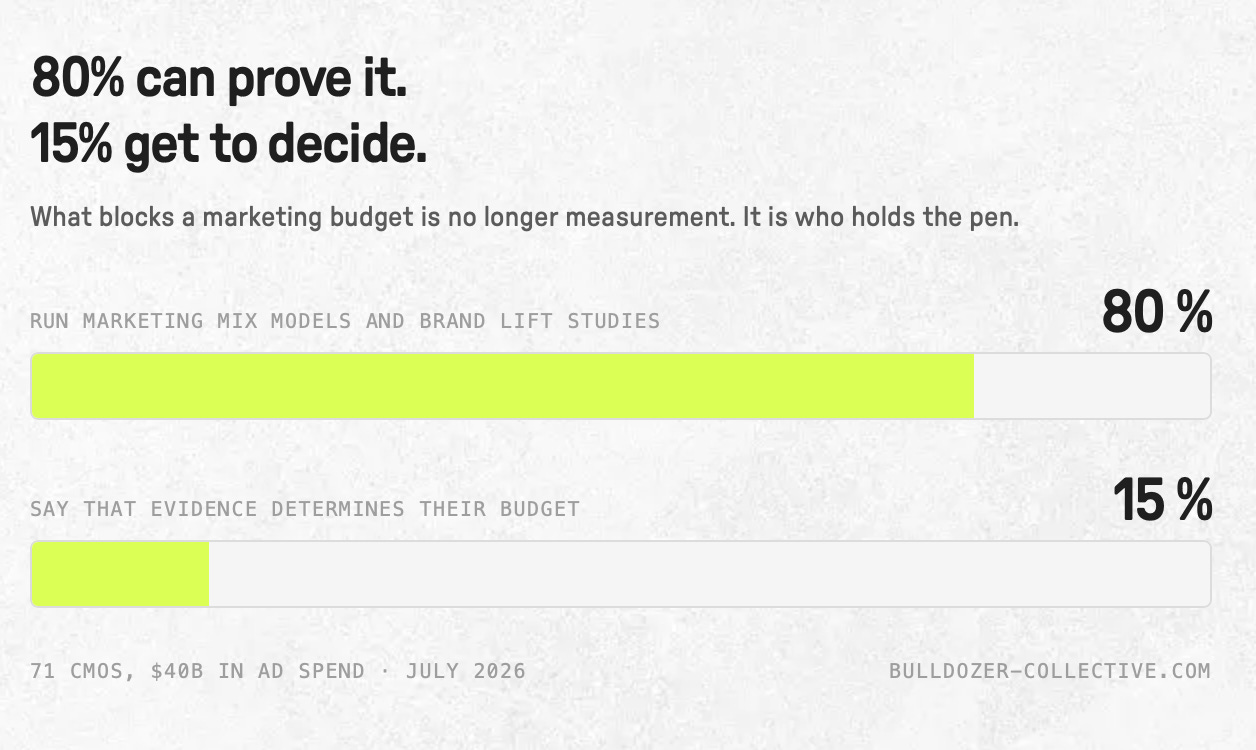
The bottleneck is authority, and it sits one floor above the analytics team. Ten years of “marketers must prove their value” advice was aimed at a problem the tooling had already solved.
3️⃣ Marketing will never become an asset.
That is the structural reason, and almost nobody in marketing talks about it!!!
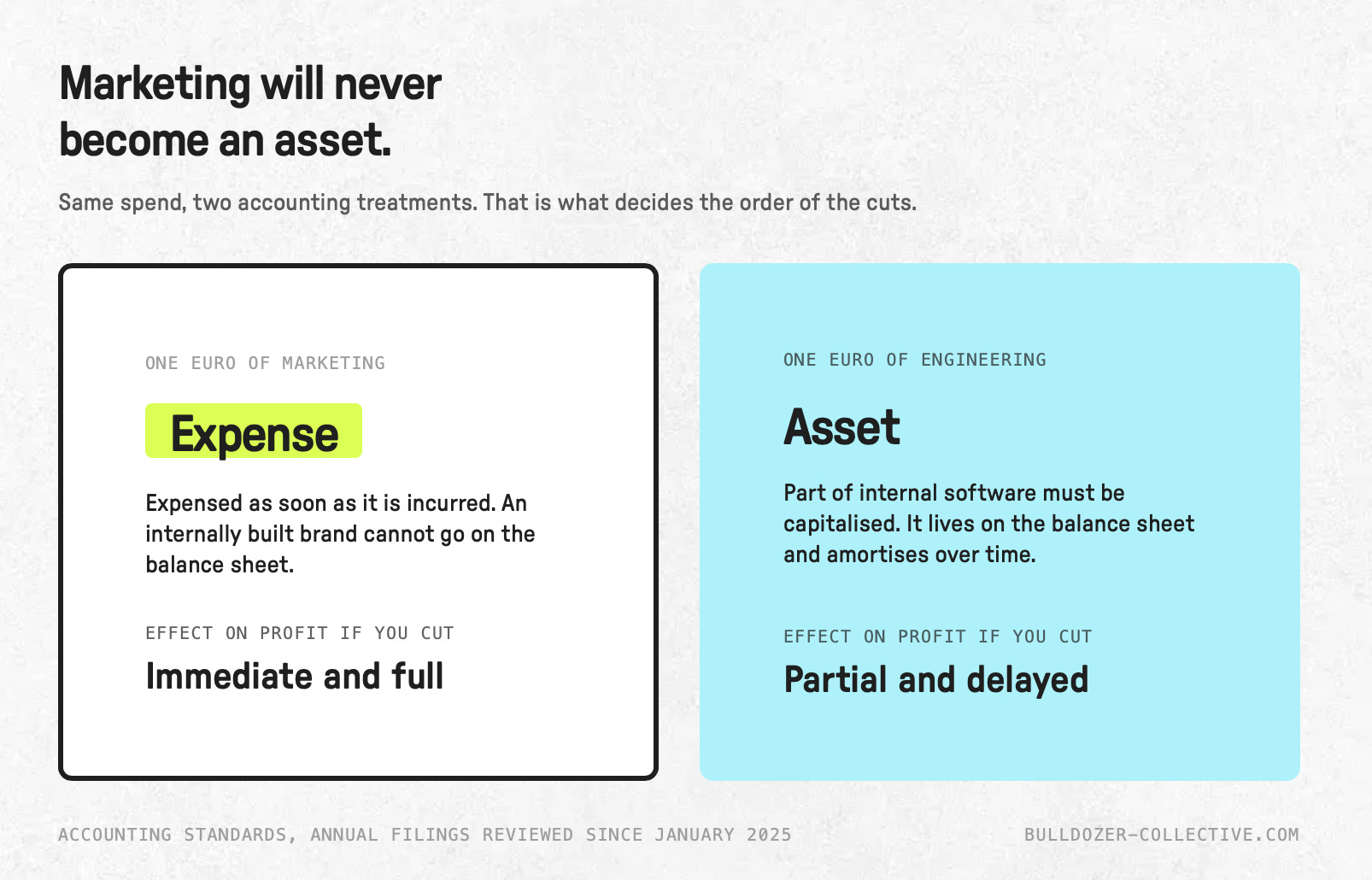
Accounting standards require advertising to be expensed as soon as it is incurred, and explicitly forbid putting an internally built brand or customer list on the balance sheet. The same standards require part of internal software development to be capitalized. Cut a euro of marketing and operating profit improves immediately and in full. Cut a euro of engineering and you hit a capitalized line, so the effect is partial and delayed.
Your CFO is not being unfair. They are applying a framework in which everything you build is a cost, and everything engineering builds is property. Even when you start building things yourself, with AI!
So marketing leaders are funding their own death, enthusiastically, and calling it modernization.
Seven decisions before the budget round
1. Ask for a separate AI line, now. Not after the budget round. Once AI lives inside the marketing envelope, every future euro of AI comes out of media, people or agencies. A separate line makes the trade visible to the people making it.
2. Price what you are about to cut. Before killing a production line or an agency retainer to fund a pilot, calculate the pipeline that line produced last year. Bring both numbers to the same meeting.
3. Break the budget into blocks. Patrick Shea, who runs the marketing budget at BlueVoyant, splits his by category, then by region, then by sub-category. When finance understands that each block behaves differently, it stops challenging line items one by one.
4. Replace cost per lead with cost per opportunity. Total spend divided by all new opportunities created, including the pipeline sales generate without you. Shea’s view: if marketing is doing its job, sales close their own deals more easily too (and I completely agree). Owning the whole number ends the attribution argument before it starts.
5. Show the calculation before anyone asks for it. Set a target off the baseline. If cost per opportunity is 5,000 euros, commit to 2,500 euros, and run the same math on every significant spend before you launch it.
6. See finance every week, not every quarter. Shea keeps a plain spreadsheet with his finance counterpart. Every week: pending approval, approved, remaining, person by person. Quarterly, you defend three months of decisions at once.
7. Pick a workflow, not a task! The marketing leaders getting real results took the workflow that cost the most repetitive time, built the smallest version that could work, and proved it before scaling. Nobody who bought five tools and announced a program is in that group.
That is where we have seen the biggest results with our clients, for what it’s worth.
One budget, two options
Your 2027 budget will not be cut. It will be reallocated, from the inside, by you.
So there are two honest positions, and no third one.
Either you accept that marketing funds the company’s AI program and hands back the savings, and you say it out loud in the planning meeting, so that at least everyone knows what was traded.
Or you walk into the budget round asking for a separate line, with the cost of what you would otherwise cut already calculated.
The window is open right now, for a few weeks, while the 2027 numbers are still being written. After that, the 15.3% becomes the baseline, and next year starts from there.
Let’s grow 👊
Jordan
Sources
Gartner, 2026 CMO Spend Survey, 401 CMOs, fielded January to March 2026
The Future Works Institute, 36 CMOs and budget holders, June 2026, via Marketing Week
Bain & Company, Automation and AI Pathfinder Survey, 951 companies, June 2026
The CMO Survey, Duke Fuqua, 308 leaders, fielded January 2026
World Federation of Advertisers and Ebiquity, 71 leaders, July 2026
Exit Five, survey of 540 B2B marketers, June 2026
Accounting standards and annual filings reviewed since January 2025
Bulldozer, qualified inbound requests since 1 May 2026, more than 200 respondents