


AEO (Answer Engine Optimization) panic is everywhere.
Prospects challenge us on it at every opportunity. Clients are second-guessing their entire SEO roadmap. LinkedIn is flooded with hot takes. Everyone's got an opinion, a case study, a "game-changing insight."
SEO agencies smell blood in the water. They’re rolling out €50K “AEO strategies” faster than you can say “AI Overview.”
And if you’ve invested in SEO, are currently doing SEO, or plan to invest in it — you’re probably all asking the same question: “Is it still worth it with LLMs taking over? Should we pivot to AEO instead?”.
But here’s what you need to know: SEO and AEO aren’t two different things.
They’re the same discipline with reweighted priorities. And if your foundations are broken (thin content, zero backlinks, unstructured data), no trendy acronym will fix them.
At Bulldozer, I could easily cash in on the hype like everyone else. We’re choosing honesty over hype. Pragmatism over panic sales.
This newsletter gives you:
Strategic perspective on what AEO actually means
Proven tactics that move the needles (with Webflow’s use case)
Quick-win experiments worth testing (10 minutes to implement and minimal downside)

Before we dive in
If you're serious about understanding AEO mechanics and want the full technical breakdown, HubSpot is running a masterclass on mastering visibility in the AI era (in French).
📍March 5th, 2026 at 11:30am CET - Sign-up for free

And if you’re curious about AI use cases that actually deliver ROI beyond AEO, we’re running a free webinar tomorrow (February 25th at 11 AM CET, in French) covering 4 high-impact plays:
AEO implementation that works
Building marketing mini-apps with AI
Scaling visual creation via AI
ABX (Account-Based Experience) at scale

Now, let’s talk AEO.
Same pillars, different weights
If you rank on Google, you’re already positioned to show up in LLM answers.
A Seer Interactive study (covered by Search Engine Land) found a 0.65 correlation between ranking on Google’s first page and being cited by ChatGPT and other LLMs.
Same pattern on Google’s AI Overviews: 76% of URLs cited in AI Overviews already ranked in the top 10 on traditional Google search.
Translation: LLMs draw from the same pool of high-authority, well-structured content that Google already rewards.
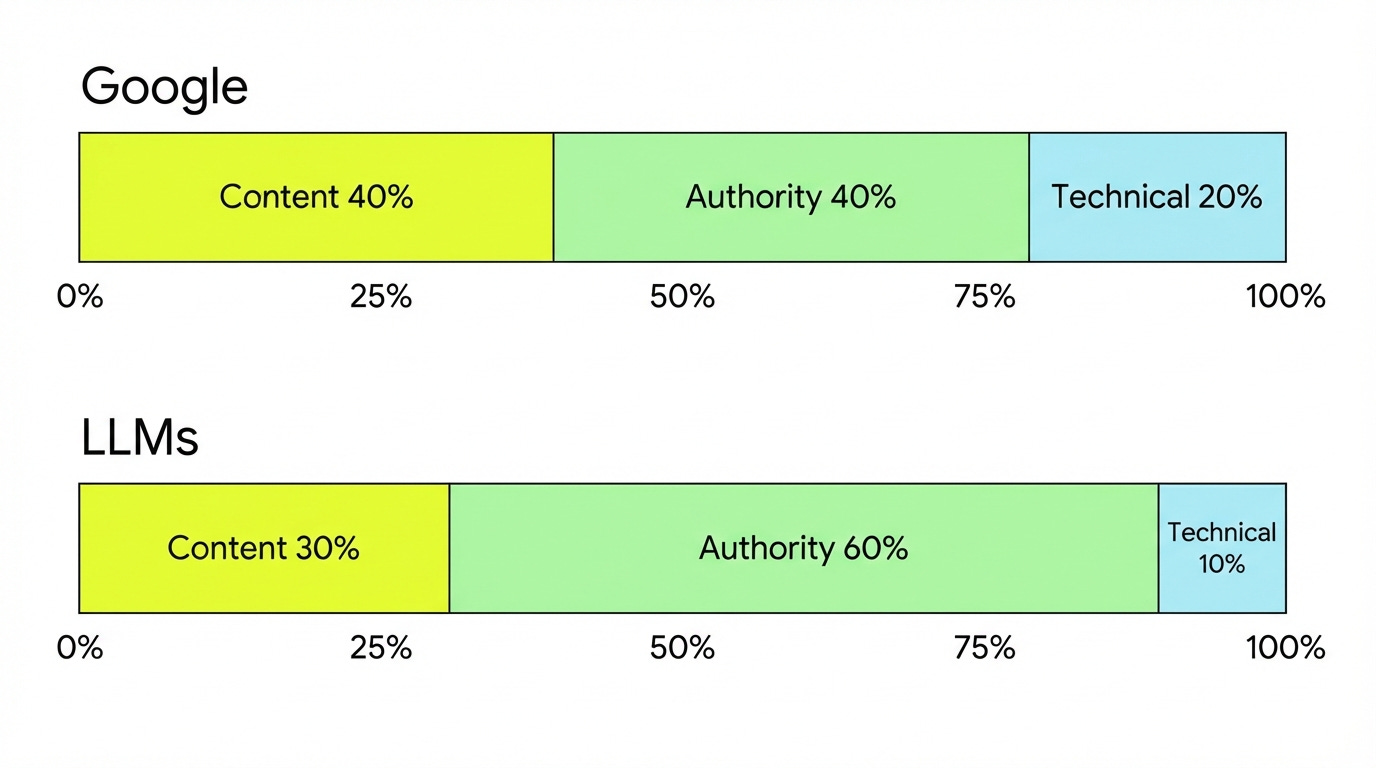
So SEO and AEO aren’t separate disciplines! In fact, the same 3 pillars apply:
Content – What you publish and how you structure it
Authority – Who links to you, cites you, talks about you
Technical – How crawlable and fast your site is
But the difference is in the weight distribution.
In 1998, Google’s big innovation was PageRank. Authority = who links to you. A link from MIT > a link from your cousin’s blog.
That system dominated for 25 years. Every SEO playbook revolved around earning backlinks from “high-authority domains.”
LLMs broke that model.
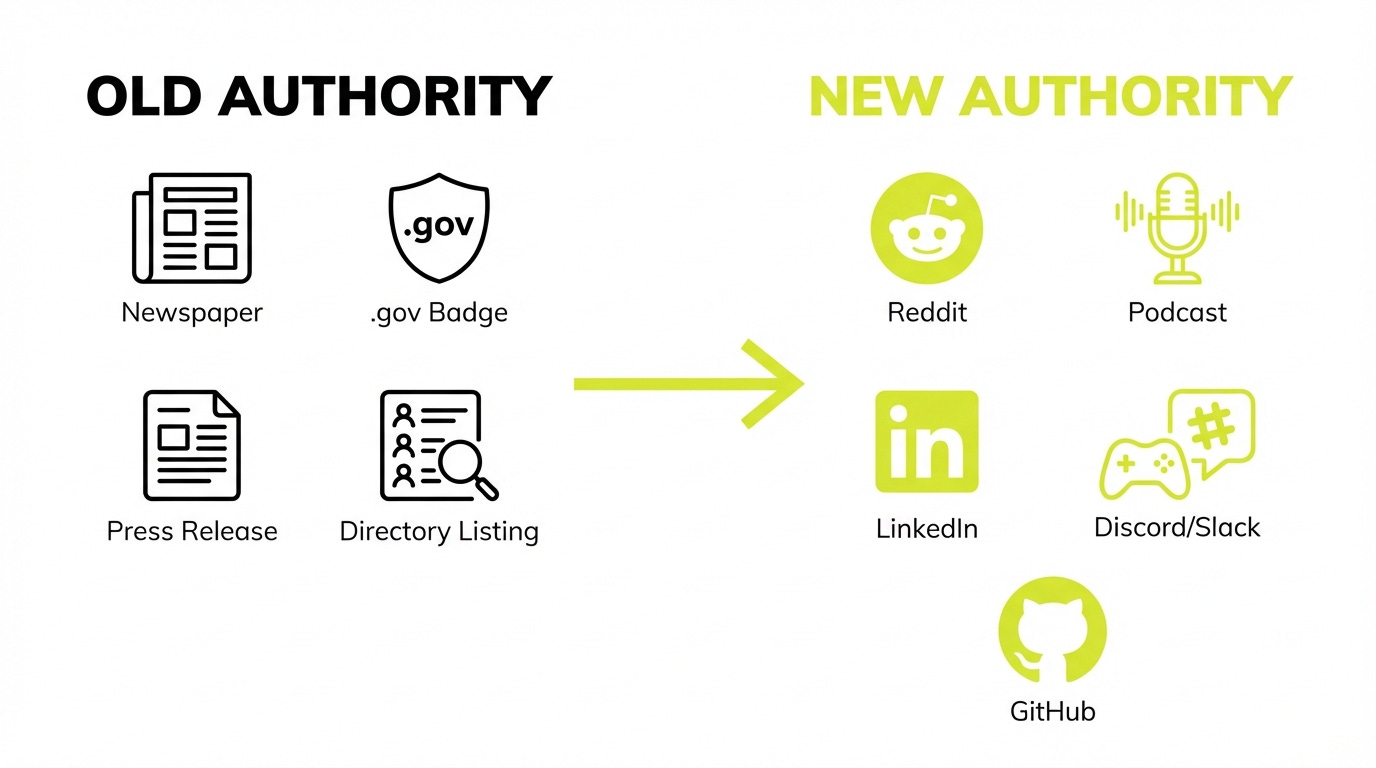
When ChatGPT trains on the internet, it doesn’t care about your “Domain Authority” score. It learns from conversations where people solve real problems. Reddit threads. Podcast transcripts. GitHub discussions. Discord servers. LinkedIn comment sections.
A mention in a Y Combinator thread about “best CRM for startups” carries more weight than a backlink from Forbes. Because the LLM learned that real buyers ask real questions in that thread — and trust the answers.
So authority matters more in an LLM world.
But it doesn’t come from the same places…
Authority has moved
Webflow’s marketing team ran an experiment last year. They wanted to see if LLM-referred traffic was real or hype.
The results:
10% of new signups now come from AI search (8x year-over-year)
LLM-referred visitors convert 3-6x better than non-brand SEO traffic
60% answer coverage across ChatGPT, Perplexity, Claude
How’d they do it? By shifting where they showed up.
🟥 Previously :
Guest posts on SaaS blogs
Backlinks from design publications
Press coverage in TechCrunch
🟩 Now:
Mentioned in r/webdev threads about no-code tools
Cited in podcasts comparing website builders
Referenced in Indie Hackers discussions about landing page tools
Same company. Different conversation venues.
The kicker: LLM-referred traffic converts better because behavior signals intent. Someone who types a 50-word question into ChatGPT has higher commitment than someone who Googles 3 keywords.
What to actually do
Based on Webflow’s data (60% answer coverage across AI platforms, +331 citations from FAQ schema alone):
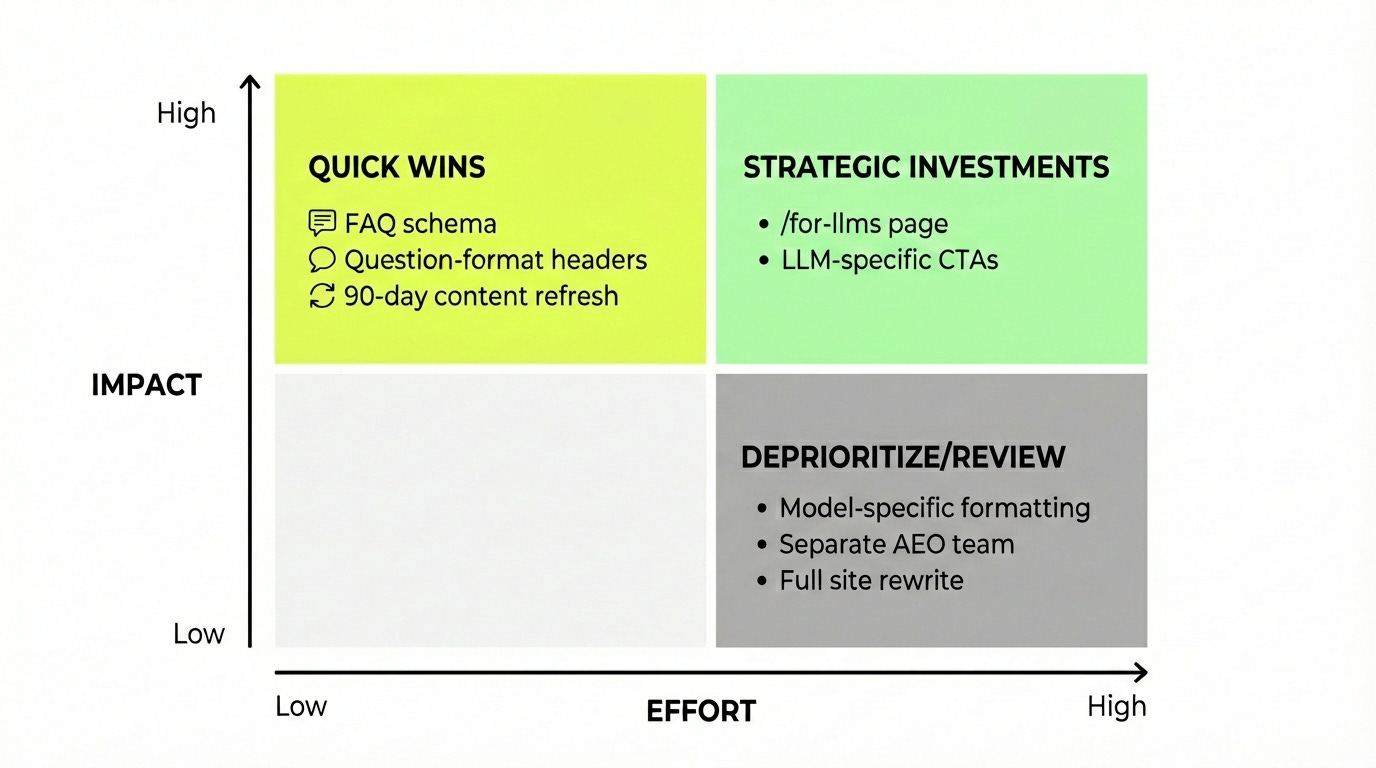
Do these first
These tactics have been validated by data; they work.
Reformat headers as questions — “How does pricing work?” beats “Pricing overview.” LLMs retrieve question-answer pairs.
Add FAQ schema to high-traffic pages — Webflow tested this on 6 pages: +331 AI citations, +149K SEO impressions in 90 days.
Refresh content every 90 days — Systematic updates drove 40% traffic lift for Webflow’s team.
Worth testing
These tactics have not yet been fully validated by data, but they are so simple to implement that it is worth putting them into practice.
LLM-specific CTAs — “Ask ChatGPT to compare us to [competitor]” with a ready-made prompt
Dedicated /for-llms page — Pigment built one with structured company data. Think of it as a “press kit” for AI models.
Skip
It. Does. Not. Work.
Model-specific formatting (GPT-4 vs Claude differences)
Separate AEO teams or budgets (👀)
Rewriting your entire site out of FOMO
Mistakes to avoid
#1. Paying $100/month for something ChatGPT does for free
There’s a growing market of GEO/AEO monitoring tools (you’ve probably seen the ads). They promise dashboards, scores, and tracking of your “AI visibility.”
Here’s how most of them actually work: they ask ChatGPT “What prompts should [brand] rank for?”, then query those prompts and display a score.
That’s it.
You can do this yourself in 5 minutes. Open ChatGPT, Perplexity, or Claude. Ask the question. Read the answer. Free.
Three reasons to be skeptical of these dashboards:
The data shifts daily. Ask the same prompt Tuesday and Thursday, get different answers. LLM outputs aren’t stable like Google rankings.
Session history biases results. If you’ve mentioned your brand before in a conversation, the model remembers. Your “visibility score” is inflated by your own usage.
The scores are fabricated. There’s no equivalent of Google Search Console for LLMs. No official API that says “you were cited X times.” These tools reverse-engineer something that doesn’t have a ground truth.
Save your budget. The manual check I described above (paste your URLs, read what comes back) gives you more honest signal than any dashboard today.
#2. The “AEO agency” trap
Related trend: SEO agencies rebranding overnight as “AEO specialists” with separate — and pricey — engagements.
The reality: AEO is SEO. Same skills, same foundations, adjusted weights. Any serious SEO engagement in 2026 should include AEO by default. If someone tries to sell you AEO as a separate line item on top of your SEO retainer, ask what exactly they’re doing that isn’t already SEO work.
At Bulldozer, all our SEO engagements now include AEO logic natively. No separate package, no acronym tax. The work is the same — done with the right priorities.
#3. Overthink how you track performance
Track three layers:
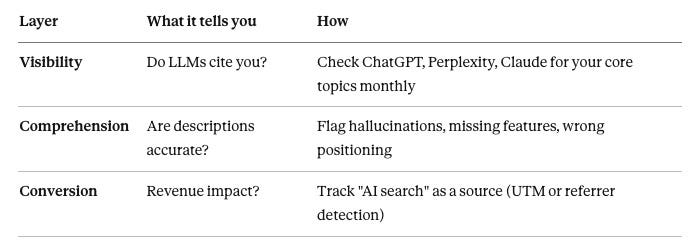
That’s it.
☑️ Your move this week
Take your top 5 pages (by traffic or revenue). Paste each URL into ChatGPT and Perplexity:
“Explain what [your company] does and who it’s for.”
Note three things:
Do they cite you at all?
Is the description accurate?
What competitors show up instead of you?
That’s your baseline. If you’re not getting cited, your authority problem is bigger than your content problem.
Let’s grow 👊
— Jordan