


On October 15th, I’m releasing a Momentum episode with Melissa Sanchot, CMO of HelloAsso—the platform one in three French nonprofits uses to get paid (subscribe here to catch it when it drops).
Small spoiler: the question was about something else entirely, and the conversation drifted into product marketing. I walked out of that studio with an idea I’d been circling for months without ever pinning it down. I haven’t stopped thinking about it since. Hence this edition.
For the past fifteen years, marketing has been a very (too?) technical job. Setting up the CRM, building campaigns, wiring tools together, chasing the dev team for a landing page… That’s where the days went, and almost nothing was left for the actual core of the job: understanding your audience and deciding what to tell them. So we did what we always do when nobody has the time. We created a new role for it.
The product marketer.
But AI is pushing all that technical work into the background (I wrote about it in The era of the “AI marketing OS”). And once it’s done, the work left for a marketer will look exactly like a PMM’s job.
That’s probably why PMM is one of the most in-demand roles right now. To me, it mostly proves the title is living on borrowed time 🚨
Accountants went through this in 1979
This idea didn’t come out of nowhere. We’ve seen this movie before.
In 1979, VisiCalc launches on the Apple II, the first spreadsheet for the masses. Until then, an accountant who wanted to test one assumption in a forecast redid every line by hand and spent their evenings on it. With VisiCalc, you change one cell and watch the whole sheet update in front of you.
Obviously, everyone predicted the end of accountants.
Decades later, Planet Money ran the numbers. Since 1980, the US has lost about 400,000 bookkeepers and accounting clerks… and gained about 600,000 accountants. The spreadsheet wiped out the arithmetic and left the expertise. And expertise ended up creating more jobs than arithmetic lost.
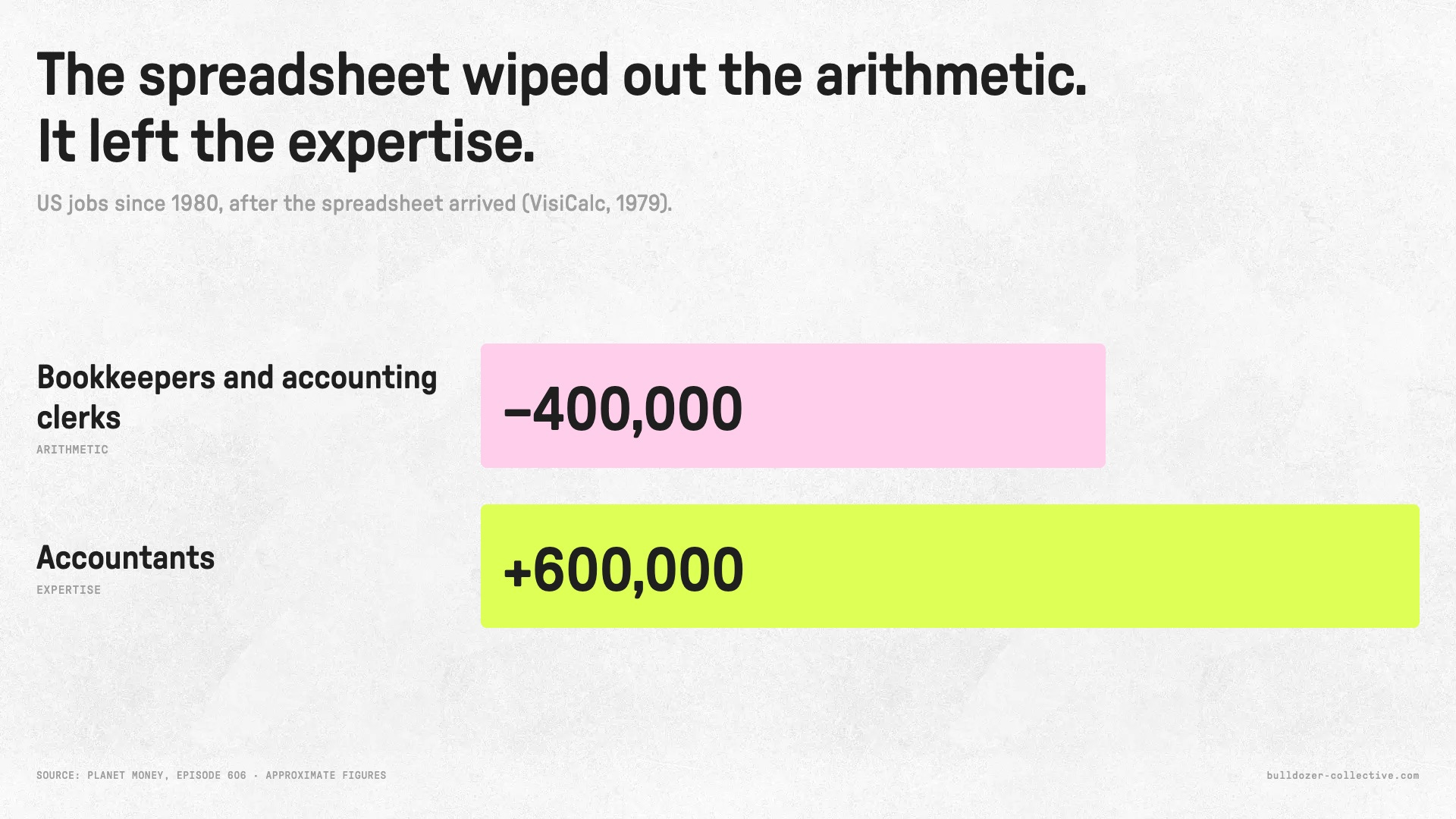
The clerks had spreadsheets too. They used them to calculate faster, and the jobs went to the people who used them to think.
Why everyone is hiring PMMs right now
With AI, any company can ship the same homepage and the same pitch as its competitors in an afternoon. Read three websites in your category back to back with the logos hidden: you’ll struggle to tell who’s who. So will your buyers 😅
Companies have figured it out. Differentiation has become THE problem, and they’re hiring specialists to fix it.
To me, that’s step one. Step two comes when execution no longer needs anyone. At that point, the work companies pay a specialist top dollar for today becomes the whole team’s job, because it’s the only work left.
You’ll tell me the time AI saves mostly goes into volume: twice the posts, twice the campaigns. True. I see it in plenty of teams (Bulldozer’s included).

Try this with your PMM’s job description
Grab it and cross out everything AI can already do. Launch decks, battlecards, one-pagers, website copy… There’s barely anything left.
Be honest: you were the only one who ever opened that last battlecard.
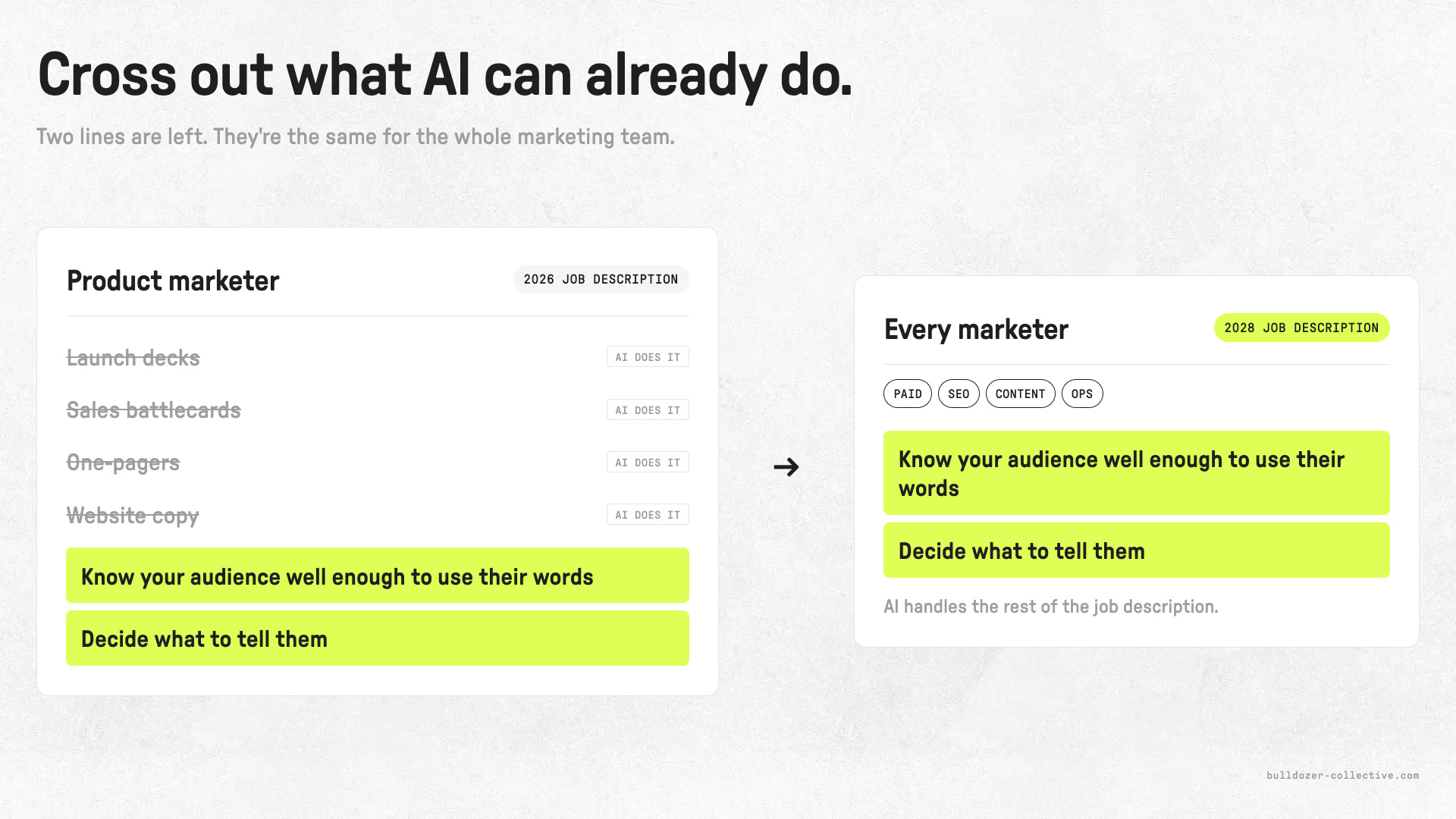
What survives comes down to two things: knowing your audience well enough to use their words, and deciding what to tell them. Now pull up the job description of your paid lead, your SEO person or your content manager, and cross out the same things. They’ll be left with those exact two lines.
Tomorrow, that’s their job too. QED.
Some companies are already there. At Ahrefs, whose CMO Tim Soulo I had on Momentum, every marketer starts in customer support, and nobody holds a PMM title. The title won’t vanish overnight: a few senior people will keep it to own the big narratives. Everything else goes to everyone.
How to turn every marketer into a PMM
1️⃣ Write your positioning once, as a team.
Half a day per quarter with leadership and sales. After that, every marketer, from paid to SEO, should be able to explain in two sentences why a customer picks you. AI turns that foundation into battlecards and pitches.
2️⃣ Put every marketer on a customer call every week.
Twenty minutes is enough. The exact words go into a shared doc, and that raw material feeds everything else.
3️⃣ Decide where the saved time goes, before it drifts into volume.
At least half the hours AI frees up go to customers and positioning. Track it monthly, like your pipeline.
And yes, this is something we help with.
Your call
You can give the time AI hands back to volume, or to your customers and your positioning. It’s the choice the clerks faced in 1980, with Claude instead of the spreadsheet.
Tomorrow, everyone’s a PMM. Or replaced by the people who already are.
Let’s grow 👊
— Jordan