Before we dive in, I wanted to take a moment to thank you for reading, responding, and sharing these newsletters throughout the year. It means a lot.
The next few days are a good time to step back, recharge, and come back sharper in January. I hope you get some proper rest — you’ve earned it.
Wishing you and your loved ones a great holiday season and a strong start to 2026.
—Jordan
Thanks for reading Bullish! Subscribe for free to receive new posts and support my work.
In 1965, Secretary of Defense Robert McNamara obsessed over body counts in Vietnam.
His analysts tracked enemy casualties with mathematical precision. Charts went up. Numbers looked good. The data said America was winning.
America was not winning.
McNamara fell into what historians now call the “McNamara Fallacy”: measuring what’s easy to measure, ignoring what actually matters, and assuming that what can’t be measured doesn’t exist.
You might be making the same mistake right now — with AI.
The threat you’re not seeing
Let’s say you’ve adopted AI tools. Lead scoring, content generation, bidding optimization, you’ve got it all. Bonus : your results improved.
But… can you explain why they improved?!
If your CFO asks “What did the AI/algorithm do to decrease CAC?” — do you have an answer beyond “it automatically optimized our audiences”?
73% of marketing teams now use generative AI. That’s a lot. But only 3% can demonstrate its business value to their boards. That’s… bad.
The real risk I see with AI: it erodes your ability to think critically about your own results. You defer to systems you don’t understand. You lose the muscle to explain what’s working.
And then you can’t do the one thing your board needs from you — tell them where to invest and why.
Why your CFO doesn’t trust your numbers
Over 60% of CFOs express skepticism about marketing performance reports.
They’re not wrong.
Research from Refine Labs found a 90% gap between what attribution software reports and what customers actually say drove their decisions. Podcast content was credited with 53% of revenue by customers — and 0% by the software.
Attribution was broken before AI showed up. AI just made it impossible to ignore.
Asking ‘Which touchpoint mattered most?’ is like asking which grain of sand makes a desert.
Consequence, you’ve probably assumed you must sacrifice explainability for performance. That’s a myth.
The opacity isn’t required. It’s a default setting you can change.
What your board actually wants from you
Three questions. That’s it:
Is marketing hitting its numbers?
What levers should we use to improve?
Should we invest more or less?
Dave Kellogg — former CMO, board director, Salesforce veteran — recommends 5-8 slides max. Lead with performance against targets. Speak in pipeline generation, conversion rates, cost per opportunity.
“When we’re talking to the board, we need to be board level,” he says. “Otherwise, they’re going to mistake you for the VP of marketing operations.”
Stop defending your attribution model. Start owning the whole pipeline.
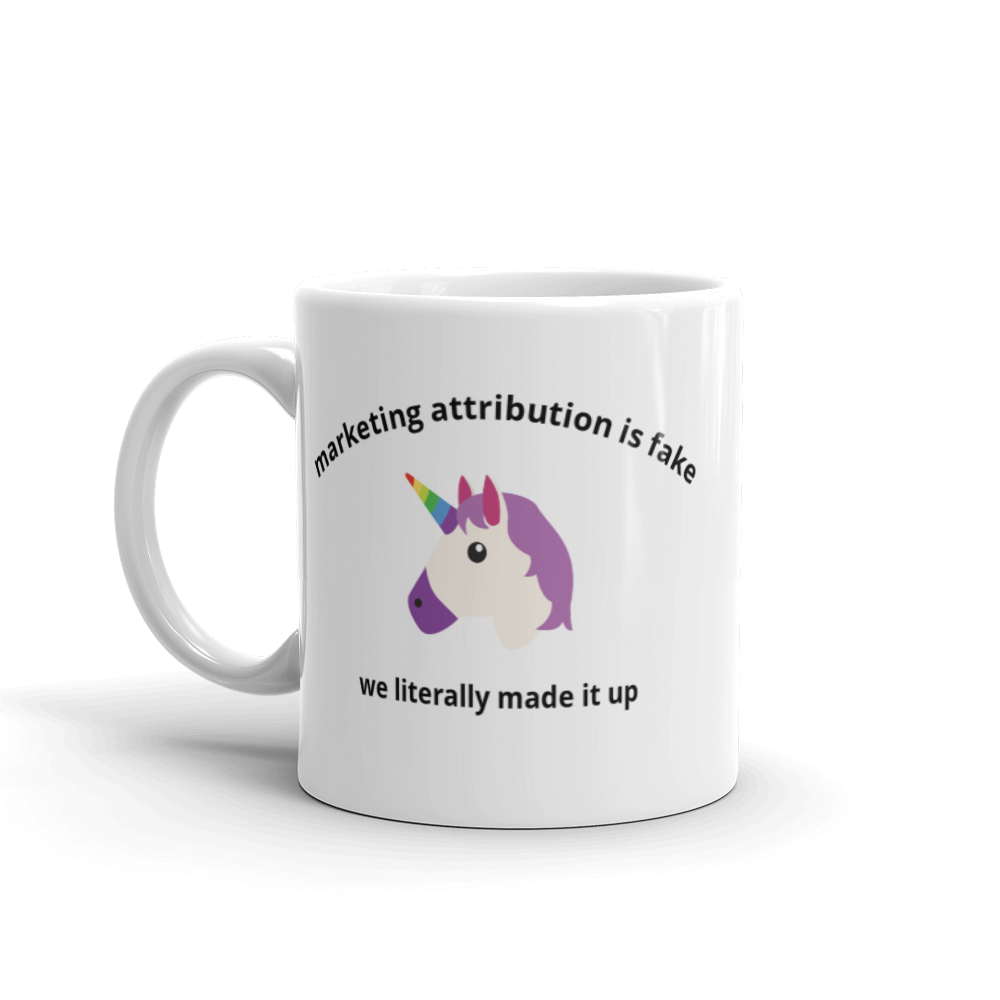
Fun fact: hekeeps a coffee mug that reads "Marketing Attribution is Fake News." He brings it to board meetings. (I want the same one 😂)
Give your board journey context instead of false precision about which touchpoint “deserves credit.”
The question you need to answer
Can you explain your results without AI?
If the answer is no, you don’t have a competitive advantage. You have a dependency — and a career risk you can’t see until it’s too late.
CMO tenure among Top 100 Advertisers dropped to 3.1 years. The lowest since 2009. But here’s the flip side: companies with strong CMO-CFO alignment grew EBITDA 12% faster.
The gap between CMOs who thrive and CMOs who churn? Explainability.
McNamara eventually admitted his mistake. In his 1995 memoir: “We were wrong, terribly wrong.”
He had all the data. He had none of the understanding.
You don’t need to wait 30 years.
AI didn’t break your measurement. It exposed that measurement was never as solid as you thought. Use that as an opening — reset expectations with your board about what can and can’t be tracked.
Hope this helps.
Let’s grow 👊
—Jordan
Sources:
Gartner, CMO Survey
McKinsey, Marketing & Technology Leaders Study
IBM, Marketing & Sales Executives Survey, 2025
IAB, State of Data Report, 2025
Dave Kellogg, kellblog.com
Harvard Business Review, David Martens et al., AI Explainability Research
Funnel.io, Board Pressure on CMOs, 2023-2025
Thanks for reading Bullish! Subscribe for free to receive new posts and support my work.



Very solid new format, keep growing!