


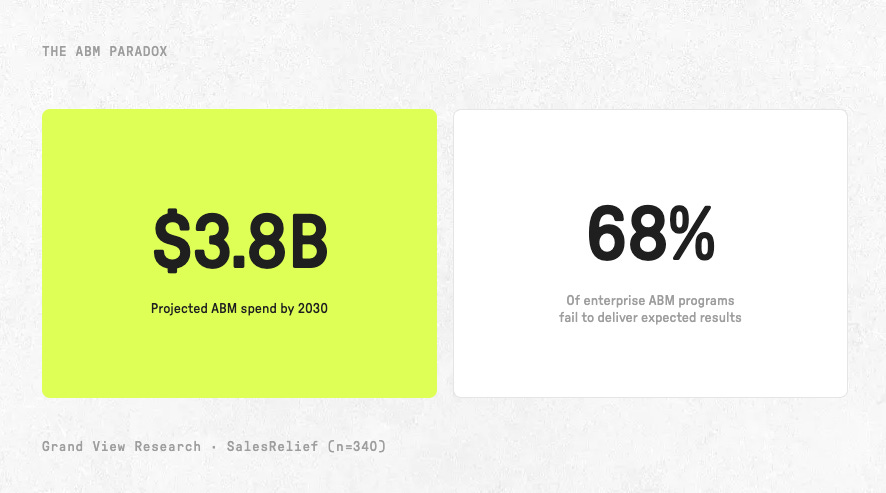
Companies will spend $3.8 billion on ABM by 2030. The #1 reason is that the stack keeps getting fancier. Clay. 6sense. Demandbase. Intent data layered on intent data.
Though 68% of enterprise ABM programs still fail to generate expected results, and only 26% of teams call their program “truly successful” (N.Rich, 2025).
The common explanation: bad execution, wrong tools, not enough budget. After running 40+ ABM and ABX programs at Bulldozer, we see something different. The failure is almost never in the execution layer. It is in the targeting layer. Specifically: fuzzy ICP.
Today, Much of what companies call ABM is actually sales executions using marketing channels. And the reason it happens is that teams skip the ICP work and jump straight to the tech.
A Tale of Two Account Lists
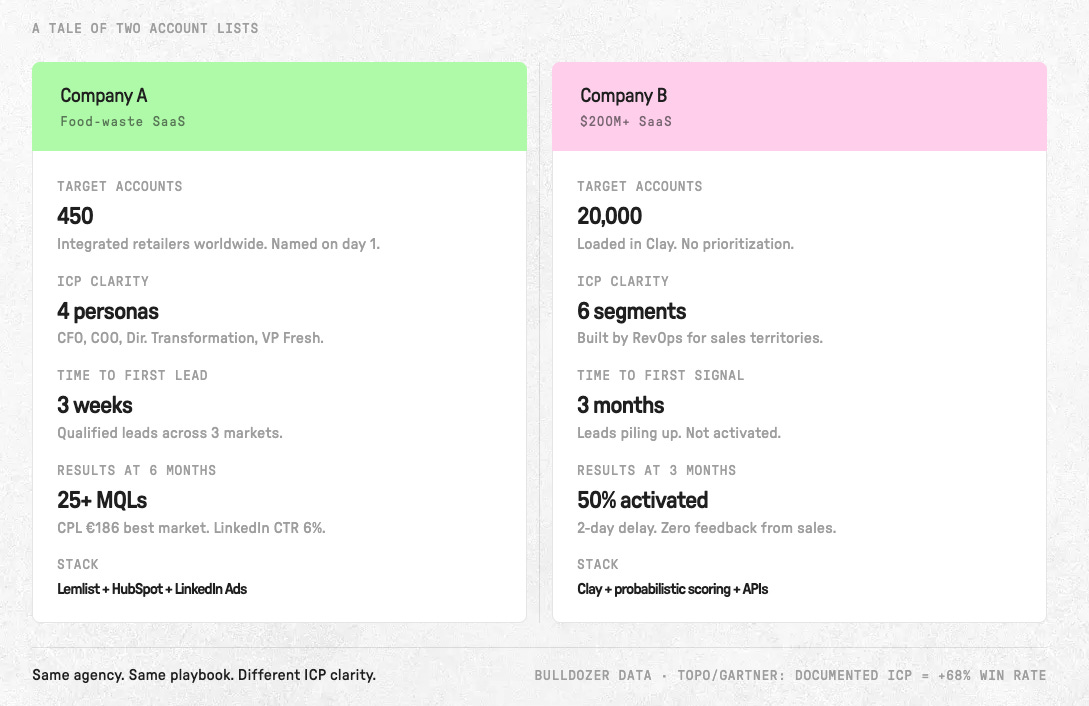
We ran two ABM programs in the same 6-month window. Same agency. Same playbook. The results had nothing in common.
Company A sells food-waste software. Their CMO walked into our first call and said something most marketing leaders cannot: “There are exactly 450 integrated retailers in the world who could buy this. Here are their names.” Four buyer personas. No debate. No territory math. Just a list that fit on two pages.
Three weeks in, qualified leads started coming. By month six: 25+ MQLs across three markets, cost per lead at €186 in their best region, and a LinkedIn CTR that peaked at 6%. Their stack was Lemlist, HubSpot, and LinkedIn Ads. Nothing fancy.
Company B is a $100M+ SaaS. They came to us with 20,000 accounts loaded in Clay. Six segments, built by RevOps to carve equal sales territories. The VP Growth told us in our second meeting: “Those six segments? I don’t believe in them.” 🥲
The scoring model was probabilistic, multi-dimensional, inherited from their self-serve funnel. We flagged it early: “You are applying self-serve logic to ABM.”
Three months later, leads were piling up. Sales was processing half of them, two days late.
Same agency. Same methods. Company A spent a fraction of the budget. Had 1/40th the accounts. Used simpler tools. The difference: Company A knew exactly who to talk to. Company B was still figuring it out.
External data backs this up: companies with a documented ICP see 68% higher account win rates (TOPO/Gartner).
The Three Traps That Kill ABM Before It Starts
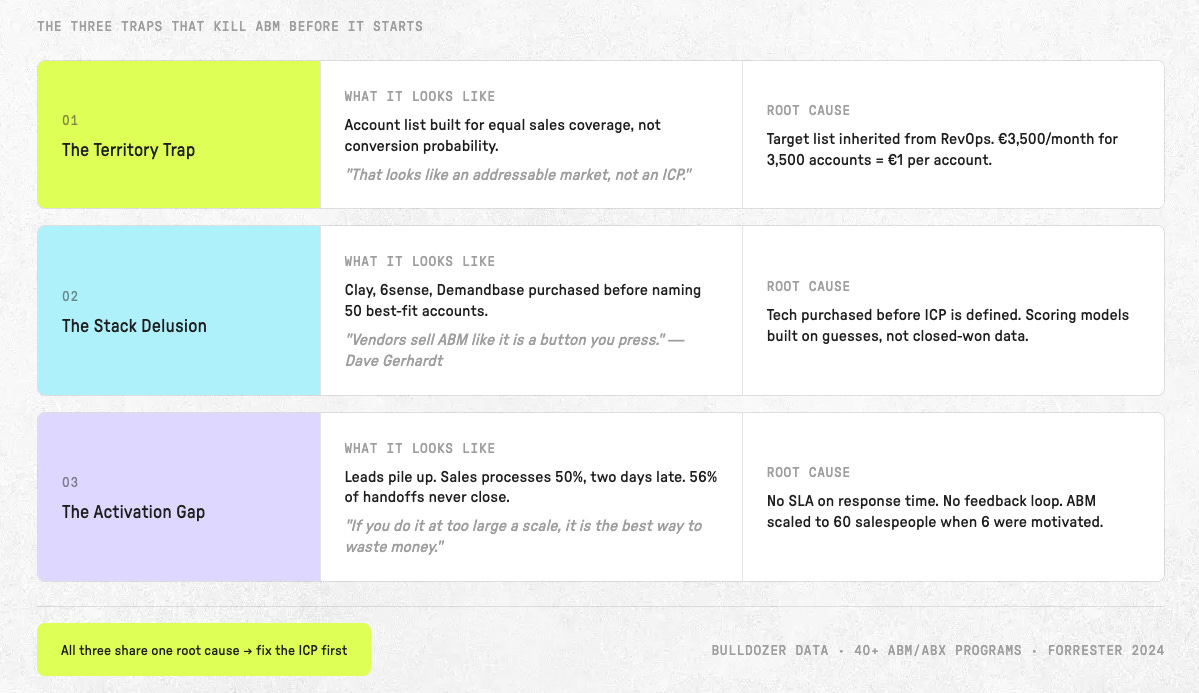
Three patterns repeat across the 40+ programs we have run.
🩸 The Territory Trap.
Most ABM target lists come from RevOps. They are built for equal sales coverage, not for conversion probability. One client had an ICP defined as “250 to 5,000 employees.” Our growth lead looked at it and said: “That looks like an addressable market, not an ICP.” They had a €3,500 monthly budget for 3,500 accounts. One euro per account per month. Looks like a mailing list to me…
🩸 The Stack Delusion.
Teams buy Clay, 6sense, and Demandbase before they can answer “who are our 50 best-fit accounts?”. The Snowflake ABM team wrote about this: “Companies buy into the promise that ABM can be done via technology as an all-in-one, without realizing they have to power that tech with their own strategies.”
Vendors sell ABM like it is a button you press. ABM is a strategy, not software.
🩸 The Activation Gap.
Targeting can be right and the program still fails when sales cannot process the output. 56% of opportunities handed to sales never close (Forrester, 2024). A former Head of Marketing at a $1B+ analytics company told us about rolling ABM out to 60 salespeople: “Maybe 6 or 7 were actually motivated. If you do it at too large a scale, it is the best way to waste money.” They later cut from 2,000 accounts to 500. That is when it started working.
I like Allan Dib’s analogy: a 100-watt lightbulb lights a room; a 100-watt laser cuts steel. Same energy, different focus. The companies spending less on ABM with a tight ICP outperform those spending more with a wide net.
Five Moves to Fix the Foundation
1. Run the ICP regression before buying any tool.
Pull your closed-won deals from the last 24 months. Segment by ACV, sales cycle length, expansion rate, win rate. Kellogg (soon on Momentum 👀) calls this the shift from “ICP as aspiration” to “ICP as regression.” At Bulldozer, we analyzed 1,495 deals and found a 0.84 correlation between initial budget above €25K and high customer lifetime value. Your ICP is in your deal data. Not in your CRM segments.
2. Apply the Geoffrey Moore test.
“Big enough to matter, small enough to lead, good fit with your crown jewels.”
If your target account list has more than 500 accounts, run the math: monthly ABM budget divided by number of accounts. Below €50 per account? You are spreading too thin. Company A had 450. The D-Day logic: concentrate force on one beachhead. Do not spread across the coast.
3. Score Activation Readiness, not just Account Fit.
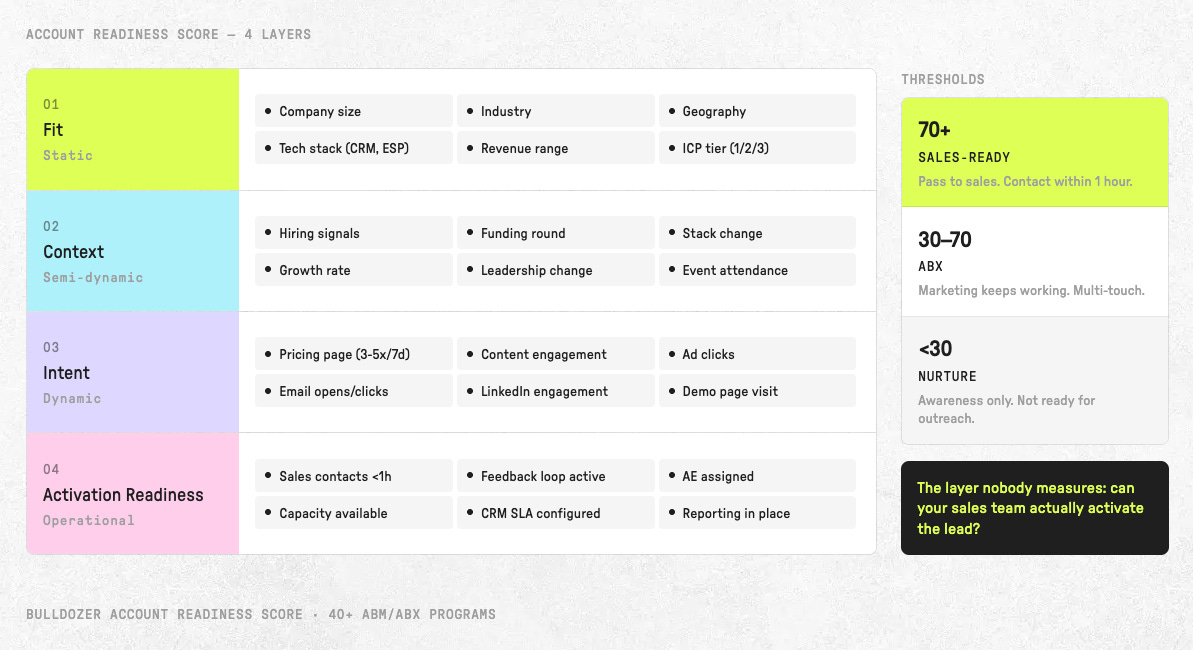
Most scoring stops at firmographics and intent. We use four layers:
+ Fit (firmographic + technographic, static)
+ Context (hiring signals, funding rounds, stack changes, semi-dynamic)
+ Intent (pricing page visits, content engagement, ad clicks, dynamic)
+ Activation Readiness (can sales contact within 1 hour? is there a feedback loop? operational).
That fourth layer is what everyone skips. From our data: even if context is strong and there is no engagement, the account is not ready. Marketing needs to keep working. And the inverse: a perfect-fit account where sales takes 2 days to respond is a burned lead.
4. Report pipeline by ICP tier in every QBR.
Kellogg flags the “false focus” trap: most ARR sits outside your top ICP tiers and nobody notices. Make ICP tier a required CRM field. Review quarterly. If more than 40% of pipeline comes from outside Tier 1-2, your ABM program is running on the wrong list.
5. Run the €1 test.
Monthly ABM budget divided by number of target accounts. If the result is under €50, you do not have enough budget for that list size. Shrink the list or increase the budget. No middle ground.
450 Accounts or 20,000?
You can keep optimizing the stack. Better scoring, more intent signals, fancier dashboards. Or you can answer one question first: do you actually know who your best customers are?
Company A knew. 450 accounts. Leads in 3 weeks.
Company B did not. 20,000 accounts. Three months of expensive silence.
The most expensive ABM program is the one targeting the wrong accounts.
Let’s grow 👊
— Jordan